
Every year, more than 1.3 million medication errors happen in U.S. hospitals. Many of these aren’t caused by careless staff-they’re the result of simple human mistakes under pressure. A pharmacist grabs the wrong bottle. A nurse misses a dosage change. A patient gets the right drug, but the wrong strength. These aren’t rare accidents. They’re preventable. And one of the most effective tools stopping them? Barcode scanning.
How Barcode Scanning Works in a Pharmacy
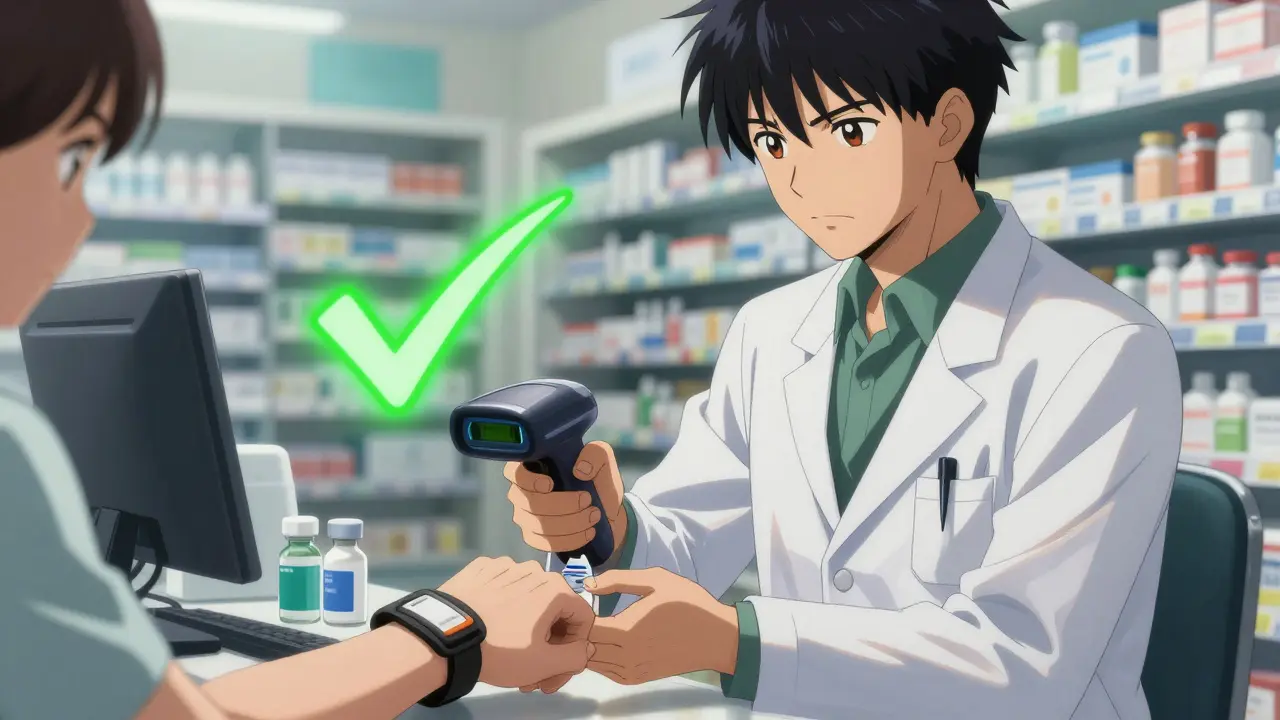
At its core, barcode scanning in pharmacies is a two-step verification system. When a medication is ready to be given to a patient, the pharmacist or nurse scans two barcodes: one on the patient’s wristband and one on the medication package. The system instantly checks if they match. If the drug, dose, route, or patient doesn’t line up, it stops the process. No scan. No release.
This isn’t just a checklist. It’s a real-time safety net built around the five rights: right patient, right medication, right dose, right route, right time. Before barcode systems, pharmacists relied on visual checks and double-checks by hand. Those methods caught only about 36% of errors. Barcode systems catch 93.4%.
The technology uses either 1D linear barcodes (the classic black-and-white stripes) or 2D matrix codes (square patterns that hold more data). Most medications today carry a National Drug Code (NDC) barcode, required by the FDA since 2006. Newer 2D barcodes can include lot numbers, expiration dates, and even batch-specific info-making it easier to track recalls or contamination.
What Errors Does It Actually Prevent?
Let’s look at real numbers from hospitals that implemented barcode scanning:
- Wrong patient errors: Reduced by 92%
- Wrong drug errors: Reduced by 89%
- Wrong dose errors: Reduced by 86%
- Wrong route errors: Reduced by 84%
One Pennsylvania hospital tracked its results before and after installing the system. Staff accuracy jumped from 86.5% to 97%-a 10.5% improvement in just a few months. That’s not a small win. That’s 10 more patients per 100 who get the right medication.
One pharmacist at Kaiser Permanente shared a story: a 10x overdose of levothyroxine was flagged by the system. The label was correct, but the vial inside was wrong. Without the barcode scan, the patient would’ve swallowed a lethal dose. The system didn’t guess. It didn’t assume. It verified. And it saved a life.
Why Manual Checks Aren’t Enough
Pharmacists have been doing double-checks for decades. But humans get tired. We get distracted. We rush during peak hours. A 2023 survey of 1,247 pharmacists found that 41% admitted to skipping scans during busy shifts. That’s not negligence-it’s burnout.
Barcode systems don’t get tired. They don’t miss a detail because they’re thinking about their next break. They don’t confuse similar-looking labels. A vial of insulin and a vial of vancomycin can look almost identical. But their barcodes? Totally different. The system doesn’t care what it looks like. It only cares what the code says.
Even the most experienced staff can make mistakes. A 2008 Pennsylvania Patient Safety Authority report showed a case where a pharmacy put the correct barcode on the wrong medication. The scanner approved it. The nurse gave it. The patient nearly died. That’s the danger of trusting the machine without verifying the physical product. That’s why experts say: scan, then verify. The barcode is the first gate. Your eyes are the second.
Where It Falls Short
Barcode scanning isn’t magic. It has limits.
Some medications don’t come with barcodes. Ampules, insulin pens, emergency kits, compounded drugs-these often have tiny, damaged, or missing codes. In one hospital, pharmacists had to create special trays with built-in scanners just to handle ampules. Another pharmacy reported that 15% of all scanning attempts fail because the barcode is smudged, torn, or printed poorly.
Then there’s the problem of workarounds. When a barcode won’t scan, some staff just hit “override” and move on. A 2022 AHRQ study found that 68% of hospitals with barcode systems still have staff who bypass them during emergencies or high-pressure moments. That’s the biggest threat to safety-not the technology failing, but people learning to ignore it.
Another issue? Labels. If a pharmacy prints a wrong label with a correct barcode, the system won’t catch it. That’s why experts like the Institute for Safe Medication Practices (ISMP) insist: always verify the medication visually after scanning. The barcode tells you what’s supposed to be there. Your eyes tell you what actually is there.
How It Compares to Other Safety Tools
Barcode scanning isn’t the only tool in the safety toolbox. But it’s one of the most effective.
Smart pumps, used for IV medications, prevent dosing errors but only work for intravenous drugs. They don’t help with oral pills or injections. Barcode scanning covers everything.
RFID tags are emerging-they can track location and movement-but they’re 47% more expensive per unit than barcodes. For most pharmacies, the cost doesn’t justify the marginal gain.
Computerized order entry (CPOE) stops errors before a prescription is even filled. But if the order is wrong and gets printed, barcode scanning is the last line of defense. The two work best together.
And unlike AI systems still in testing, barcode scanning is proven, affordable, and widely available. It’s not the future. It’s the present-and it’s working.
Real-World Challenges and Solutions
Implementing barcode scanning isn’t just about buying scanners. It’s about changing how people work.
Most pharmacies need 8 to 12 weeks of training before staff feel comfortable. Common problems include:
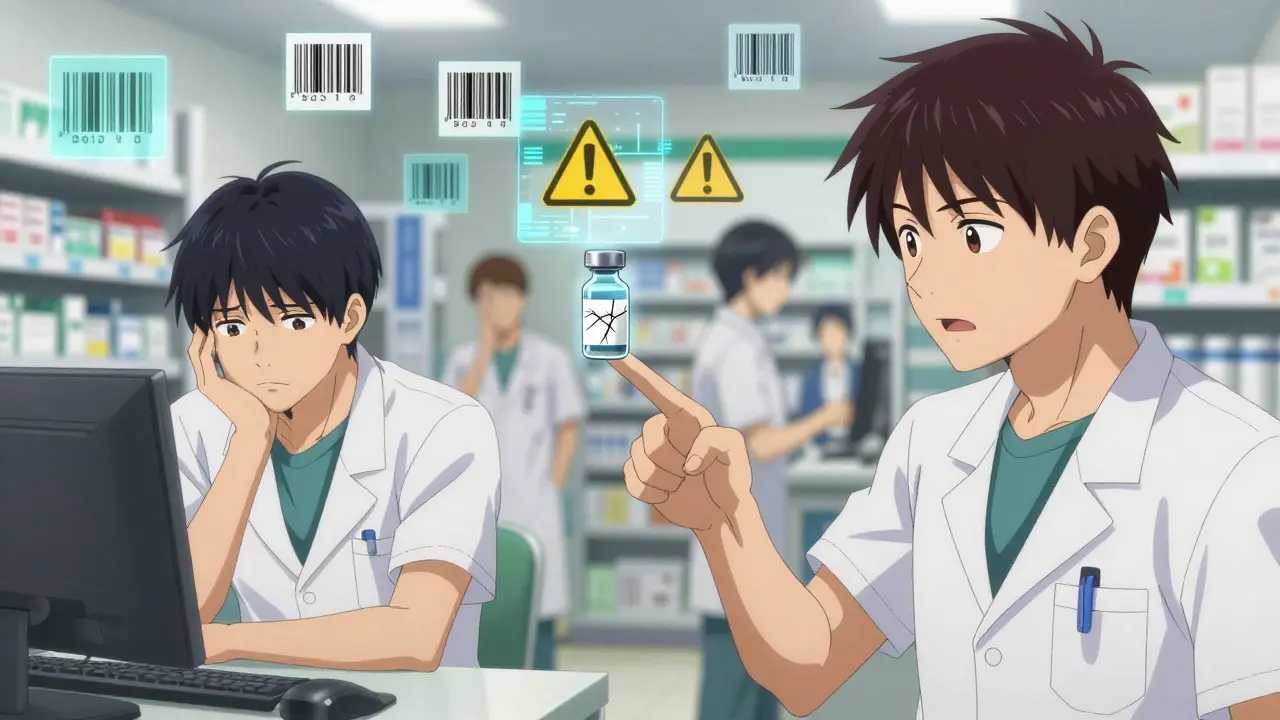
- Scanner freezes during rush hours
- Barcodes that won’t scan on small vials
- Too many false alerts that lead to alert fatigue
Leading hospitals have fixed these with simple fixes:
- Using special scanning trays for ampules and insulin pens
- Testing new products’ barcodes before they hit the shelf
- Creating a “barcode validation team” to review high-risk medications
- Training staff to report recurring scanning issues to ISMP
One pharmacy started scanning manufacturer barcodes directly off the original packaging instead of using their own printed labels. That cut errors by 22%.
Adoption Rates and Future Trends
As of 2024, 78% of U.S. hospitals use barcode scanning. But only 35% of community pharmacies do. Why? Cost. A full system can run $50,000 to $200,000. For a small independent pharmacy, that’s a hard sell.
But the trend is shifting. The FDA is piloting 2D barcodes that store more data. By 2026, 65% of medications are expected to use them. That means more safety info packed into one scan-expiration, lot number, even storage requirements.
Companies like Epic and Cerner are adding AI to predict when barcodes will fail. Cerner’s 2025 update will use image recognition to help scanners read damaged codes. Mobile scanners are now built into tablets and phones, making scanning faster and more flexible.
Experts agree: barcode scanning isn’t going away. It’s evolving. And it’s here to stay as the backbone of medication safety for at least the next 15 years.
What You Can Do to Make It Work
If you’re a pharmacist, technician, or even a patient, here’s how you can help:
- Never override a scan without verifying the physical medication. Even if the system says it’s right, look at the drug. Compare it to the order.
- Report bad barcodes. If a product’s barcode is smudged, missing, or wrong, tell your pharmacy manager. They need to report it to the manufacturer and ISMP.
- Use manufacturer barcodes when possible. Don’t rely on pharmacy-printed labels. They’re more likely to be wrong.
- Push for training. If your team skips scans, ask why. Is it the system? The workflow? The pressure? Fix the root cause, not the symptom.
Medication safety isn’t about technology alone. It’s about culture. Barcode scanning gives you a powerful tool. But only if you use it right.
How effective is barcode scanning at preventing medication errors?
When properly used, barcode scanning prevents 93.4% of potential dispensing errors, according to a 2021 BMJ Quality & Safety study. It reduces wrong-patient errors by 92%, wrong-drug errors by 89%, and wrong-dose errors by 86%. Hospitals that fully implement the system see accuracy rates rise from around 86% to over 97%.
Can barcode scanning miss errors?
Yes. If a barcode is damaged, missing, or incorrectly printed, the system can’t read it. Even worse, if a pharmacy prints a correct barcode on the wrong medication, the scanner will approve it. That’s why visual verification is still required. The barcode is a checkpoint, not a guarantee.
Why don’t all pharmacies use barcode scanning?
Cost is the biggest barrier. A full system can cost $50,000 to $200,000, which is hard for small community pharmacies to justify. Also, some medications-like ampules or compounded drugs-don’t come with standard barcodes. Training staff and changing workflows also take time and effort.
Is barcode scanning better than double-checking by hand?
Yes. Manual double-checks catch only about 36% of errors. Barcode systems catch over 90%. Humans get distracted, tired, or rushed. Machines don’t. That’s why the American Society of Health-System Pharmacists (ASHP) recommends barcode scanning as a mandatory safety step.
What’s the future of barcode scanning in pharmacies?
The future is 2D barcodes and AI. By 2026, 65% of medications will use 2D codes that hold more data-like expiration dates and lot numbers. Vendors like Cerner and Epic are adding AI to predict and fix scanning failures before they happen. Barcode scanning won’t be replaced-it’ll get smarter.
Dayanara Villafuerte
January 18, 2026 AT 11:09Barcodes saved my grandma’s life. She got the wrong insulin dose once before they installed this system. I still get chills thinking about it. 🙏 Now? She’s 89 and still hiking. Tech isn’t perfect, but it’s the difference between ‘oh no’ and ‘thank god’.
Praseetha Pn
January 19, 2026 AT 17:40Let’s be real-this isn’t about safety. It’s about corporations forcing tech down our throats so they can track every pill you swallow. Who’s got access to that data? Who’s selling it? You think the FDA cares about your life? Nah. They care about liability. And you? You’re just another data point in their algorithm. 🔍💀
Stacey Marsengill
January 20, 2026 AT 14:01Wow. So now we’re trusting machines over trained professionals? How quaint. My cousin’s a pharmacist. She works 12-hour shifts, does 300 scripts a day, and still remembers every patient’s allergies. You think a barcode knows that Mrs. Thompson can’t have sulfa? Please. This is just lazy healthcare.
Ryan Otto
January 21, 2026 AT 05:33Statistical cherry-picking. 93.4%? Where’s the control group? How many false positives were generated? How many staff were coerced into compliance under threat of termination? The data is sanitized. The narrative is manufactured. The real issue is systemic understaffing-and this is a Band-Aid on a hemorrhage. The system doesn’t prevent errors. It shifts blame.
Jodi Harding
January 22, 2026 AT 17:45Scanning doesn’t replace judgment. It just gives you a better chance to use it.
Andrew Qu
January 22, 2026 AT 18:22My hospital went full barcode in 2020. First month? 12 overrides. Second month? 3. Now? We almost never do. The key isn’t the tech-it’s the culture. Train people. Listen to their complaints. Fix the broken scanners. Make it easy. Then the system works. Simple.
rachel bellet
January 23, 2026 AT 18:21Per the ISMP’s 2023 Safety Benchmark Report, the integration of barcode-enabled CPOE with real-time alerting reduces preventable ADEs by 42% compared to standalone barcode systems. The synergy between workflow automation and human oversight is the critical variable-not the barcode itself. Without proper governance, the system becomes a compliance theater.
Robert Davis
January 25, 2026 AT 11:15They say it’s 93% effective. But what about the 7%? The ones that slip through? The ones where the barcode is right but the pill is wrong? That’s the scary part. We’re not safer. We’re just more confident we’re safe. And confidence kills.
Selina Warren
January 27, 2026 AT 04:51Look. I get it. You’re tired. You’re overworked. You’re sick of being treated like a cog. But let me tell you something-this isn’t about replacing you. It’s about protecting you. Imagine waking up tomorrow and hearing that someone died because you missed a label. That’s not burnout. That’s a legacy. This system doesn’t take away your skill. It gives you a shield. Use it. Don’t curse it. We need you alive, not just efficient.
Tyler Myers
January 28, 2026 AT 12:33They say barcodes prevent errors. But what if the barcode is wrong? What if the label was printed wrong? What if someone swapped the vials and just stuck on the right barcode? You think the machine knows the difference? Nah. It just scans. And then you’re left thinking you’re safe while your patient’s liver is failing. This isn’t safety. It’s a placebo for guilt.
Robert Cassidy
January 30, 2026 AT 07:02America’s healthcare is a circus. We spend $4 trillion a year and still let people die because a nurse was tired. Now we slap on barcodes like it’s a magic spell. Meanwhile, the real problem? No one gets paid enough. No one gets enough sleep. No one gets respect. You don’t fix burnout with scanners. You fix it with dignity. But that’s too expensive for the CEOs, isn’t it?
kenneth pillet
February 1, 2026 AT 06:59used to work in a small pharmacy. we skipped scans all the time. not because we were lazy. because the scanner would freeze during lunch rush. we had to reboot it. took 3 mins. patients were waiting. we did the double check. never messed up. barcodes are nice. but they’re not magic. trust your eyes first. the machine second.
Aysha Siera
February 2, 2026 AT 14:43they’re putting barcodes on insulin pens now. that’s a joke. the pen is smaller than the barcode. they’re not fixing problems. they’re just making paperwork bigger. and someone’s gonna die because a tiny sticker fell off
Eric Gebeke
February 3, 2026 AT 10:45It’s not about the barcode. It’s about the fact that we’ve outsourced critical thinking to machines. We used to train pharmacists to be experts. Now we train them to be barcode operators. And when the system fails-because it will-we have no one left who can think for themselves. This isn’t progress. It’s decline dressed up in tech.