
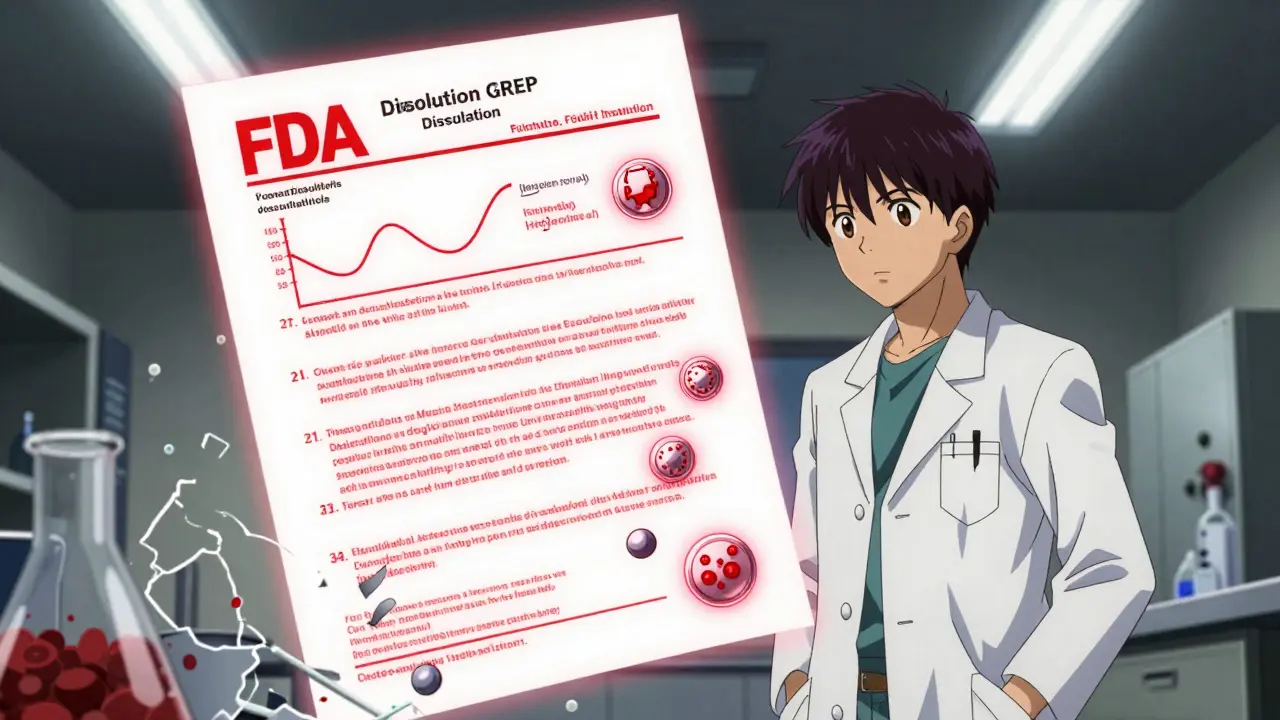
When a generic drug company submits an application to the FDA, they’re not just asking for permission to sell a medicine-they’re asking to prove it’s just as safe and effective as the brand-name version. But more than half the time, that application doesn’t pass on the first try. Why? Because of something called a deficiency letter.
A deficiency letter isn’t a rejection. It’s a detailed checklist from the FDA telling you exactly what’s missing, wrong, or unclear in your application. For generic drug makers, this is often the biggest roadblock between a promising product and a profitable one. And the worst part? Most of these issues are preventable.
What Exactly Is a Deficiency Letter?
A deficiency letter comes from the FDA’s Center for Drug Evaluation and Research (CDER) after they’ve reviewed an Abbreviated New Drug Application (ANDA). It’s not a vague comment or a polite suggestion. It’s a formal, point-by-point list of problems that block approval. These can range from missing data on how the drug breaks down in the body to flawed manufacturing controls or incomplete toxicology reports.
Since 2003, the FDA has standardized these letters to make them more transparent. Before that, feedback was scattered across informal notes. Now, every deficiency is clearly labeled, numbered, and tied to specific regulatory guidelines. That means companies can’t claim they didn’t know what was expected.
Over 70% of all major deficiencies in ANDAs are quality-related. That means the problem isn’t usually about whether the drug works-it’s about whether the company can consistently make it right, every time, at scale.
The Top 5 Deficiency Categories (and What They Really Mean)
Not all deficiencies are created equal. Some are minor. Others can delay approval by over a year. Here are the five most common categories, based on FDA data from 2023-2024:
- Dissolution Issues (23.3% of applications) - This is the #1 problem. Dissolution testing shows how quickly the drug releases its active ingredient in the body. If your test method doesn’t match the brand-name drug’s behavior across different pH levels (like stomach acid vs. intestine), the FDA will flag it. Many companies still use outdated equipment or test only at one pH, even though the FDA requires testing at 1.2, 4.5, and 6.8. For modified-release tablets, this becomes even more complex-Apparatus 3 or 4 may be required instead of the standard Apparatus 2.
- Drug Substance Sameness (19%) - The generic must be chemically identical to the brand. But “identical” isn’t just about the molecule. It’s about impurities, crystal form, particle size, and how it behaves under stress. For peptide-based drugs, you need circular dichroism and size-exclusion chromatography data to prove the protein’s 3D structure matches. Companies that skip these tests end up with a “sameness” deficiency.
- Unqualified Impurities (20%) - Every drug has impurities. The FDA doesn’t expect perfection. But they do expect you to know what’s in there, where it came from, and whether it’s safe. If you find a new impurity above 0.1%, you must run toxicology studies. Missing this step is one of the biggest delays-adding 14 to 18 months to approval. And if you’re using a Drug Master File (DMF) from a supplier, and that DMF has issues, your application fails too.
- Analytical Method Validation (16.5%) - You can’t prove your drug is safe if you can’t accurately measure it. The FDA wants proof that your testing method is precise, accurate, and repeatable. This includes validation for stability, potency, and impurity detection. Too many applicants submit a method that works in the lab but fails under real-world conditions.
- Elemental Impurities (13%) - Heavy metals like lead, cadmium, and arsenic are controlled under ICH Q3D guidelines. But many companies assume their raw materials are clean and skip testing. The FDA now requires a risk assessment for every product, and if you don’t document it, you get flagged.
Why Do So Many Companies Keep Making the Same Mistakes?
It’s not because they’re careless. It’s because they’re underprepared.
Small companies with fewer than 10 approved ANDAs have deficiency rates 22% higher than established players. Why? They often treat ANDA development like academic research-focused on proving the drug works, not on proving they can make it reliably. One regulatory consultant found that nearly half of all “sameness” failures come from this mindset.
Another big issue? Misreading the FDA’s Bioequivalence Review Manual. About 30% of bioequivalence deficiencies happen because applicants use the wrong study design for complex products like extended-release tablets or topical creams. They assume the same rules apply to everything. They don’t.
And then there’s communication. A 2023 survey of 127 generic drug companies found that 78% said poor communication with FDA reviewers led to repeated deficiencies. One company on Reddit shared how their dissolution method was rejected because they used a USP apparatus from 1995, while the FDA had updated its guidance in 2021 to require biorelevant conditions.
Complex Drugs Are the Biggest Challenge
Not all generics are created equal. A simple 500mg tablet of amoxicillin? Low risk. A peptide injection with modified-release properties? High risk.
Complex generics-like peptides, inhalers, topical creams, and extended-release tablets-make up only 22% of submissions but account for 38% of deficiency letters. Why? Because they’re harder to characterize, harder to replicate, and harder to test.
Take peptides: You can’t just run a standard HPLC test. You need Fourier-transform infrared spectroscopy, circular dichroism, and aggregation profiling. One company spent 11 months fixing a deficiency because they didn’t know they needed to compare secondary structures.
Modified-release tablets? The FDA looks at how the drug releases over time across multiple pH levels. If your release profile doesn’t match the brand’s within a narrow window, you’re out. And if your manufacturing process isn’t robust enough to maintain that profile batch after batch? Another deficiency.
How to Avoid a Deficiency Letter
Here’s what actually works:
- Do a pre-ANDA meeting. Companies that request one see deficiency rates 32% lower. You get direct feedback before you spend millions.
- Use Quality by Design (QbD) principles. Build your process with controls built in from day one. Don’t wait until the end to test.
- Validate your methods like your license depends on it. Because it does. Test across pH, temperature, and time. Document everything.
- Don’t rely on supplier DMFs without checking them. If the DMF has a deficiency, your application fails. Review it yourself.
- Write clear, detailed development reports. Applications with full documentation have 27% fewer deficiencies. The FDA isn’t looking for perfection-they’re looking for understanding.
It takes 18 to 24 months for a new company to get good at this. That’s not a suggestion-it’s a fact from FDA data tracking 47 first-time applicants.
The Cost of Getting It Wrong
Every delay costs money. Each additional review cycle adds about $1.2 million in expenses-testing, rework, legal fees, lost market time.
High-revenue generics (those with over $100 million in annual sales) have 18% fewer deficiencies. Why? Because they invest in experts, better labs, and early FDA engagement. Low-revenue products? They often cut corners-and pay for it later.
But there’s hope. The FDA’s new “First Cycle Generic Drug Approval Initiative” has already cut dissolution-related deficiencies by 15%. They’ve created template responses for the 10 most common issues. And by 2026, they plan to roll out AI tools that flag submission errors before you even hit “submit.”
By 2027, first-cycle approval rates could jump from 52% to 68%. That means more affordable drugs reaching patients faster.
Final Thought: It’s Not About Luck
Deficiency letters aren’t random. They’re predictable. And they’re avoidable.
If you’re submitting an ANDA, don’t treat it like a formality. Treat it like a technical audit with billion-dollar stakes. Understand the FDA’s expectations. Know your product inside and out. Document everything. And don’t guess.
The FDA doesn’t want to say no. They want to say yes-to safe, effective, affordable medicine. But they won’t approve a product unless they’re certain it’s done right. And that’s your job.
What happens if I ignore a deficiency letter from the FDA?
Ignoring a deficiency letter means your application won’t be approved. The FDA won’t move forward until all listed issues are addressed. If you don’t respond within the deadline (usually 12 months), your application will be withdrawn. You’ll have to resubmit from scratch, losing all prior review time and spending more money.
Can I appeal a deficiency letter?
You can’t appeal the letter itself, but you can request a meeting with the FDA to discuss their findings. This is called a Type B meeting. Use it to clarify misunderstandings, ask for examples of acceptable data, or explain why your approach is scientifically sound. Many companies turn a deficiency into approval by using this step wisely.
How long does it take to fix a deficiency letter?
It varies. Simple issues like missing documentation can be fixed in 2-3 months. But if you need new toxicology studies, method validation, or manufacturing changes, it can take 8-18 months. Impurity-related deficiencies are the slowest-often requiring new animal studies and regulatory filings.
Do all generic drug applications get deficiency letters?
No, but most do. About 48% of ANDAs receive a deficiency letter on the first review. That number drops to 12% for companies with over 50 approved products. First-time applicants are far more likely to get one. The FDA’s new initiatives aim to reduce this rate to under 35% by 2027.
Is there a way to check if my application is likely to get a deficiency letter before submitting?
Yes. The FDA offers pre-submission meetings, and many companies now use third-party consultants with FDA review experience to audit applications before submission. Starting in 2026, the FDA will also launch an AI-based screening tool that flags common errors like missing ICH Q3D reports or incorrect dissolution apparatus choices-before you even submit.
Raushan Richardson
December 27, 2025 AT 16:00Wow, this is actually one of the clearest breakdowns of ANDA deficiencies I’ve seen. I’ve been in this game for 8 years and even I learned a few things-especially about Apparatus 3/4 for modified-release. Thanks for laying it out like this.
James Bowers
December 28, 2025 AT 07:32While the article is technically accurate, it fails to address the systemic issue: the FDA’s review process is intentionally opaque, and deficiency letters are often weaponized to delay generic entry. This is not about quality-it’s about market protection for branded manufacturers.
Will Neitzer
December 29, 2025 AT 16:07Thank you for this meticulously detailed and evidence-based overview. The emphasis on Quality by Design and pre-ANDA meetings is absolutely critical. Too many sponsors treat regulatory submission as a box-checking exercise rather than a scientific endeavor. The data on first-time applicant failure rates underscores the need for structured mentorship programs in this space.
Janice Holmes
December 30, 2025 AT 12:46LET ME TELL YOU-DISSOLUTION ISSUES ARE THE DEVIL’S OWN CHECKLIST. I’ve seen a $200M product get kicked back because someone used Apparatus 2 instead of 4 for a 12-hour extended-release tablet. Eleven months. Eleven. Months. Just because they thought ‘it’s close enough.’ It’s not. It’s never close enough. The FDA doesn’t care if your drug works-they care if your test says it does. And if your test is outdated? You’re toast.
Alex Lopez
December 31, 2025 AT 00:44So let me get this straight-you’re telling me the FDA’s AI tool is coming in 2026 to catch what humans have been missing since 2003? That’s like installing a smoke alarm after the house burned down. 😅 Still, props for the breakdown. The DMF point? CRITICAL. I’ve seen companies blame suppliers while ignoring their own QA oversight. Classic.
Nikki Thames
January 1, 2026 AT 01:56Let’s be honest-this entire system is a sham. The FDA demands perfect documentation, yet refuses to provide standardized templates for critical sections. Companies are forced to guess what ‘adequate’ means, then punished for not reading the FDA’s mind. This isn’t regulation-it’s a psychological game designed to exhaust small firms. The ‘First Cycle Initiative’ is PR. Real change requires dismantling the power imbalance, not adding AI.
Chris Garcia
January 1, 2026 AT 03:41In Nigeria, we watch this with awe and frustration. We have brilliant scientists who could make affordable generics-but the regulatory burden is so high, and the cost of compliance so steep, that most never even try. This article reads like a manual for billionaires. Where is the support for low-resource countries trying to join the global generics market? The FDA’s standards are noble-but they’re not universal. And that’s the real tragedy.
Olivia Goolsby
January 2, 2026 AT 04:10Wait-so you’re telling me the FDA is going to use AI to catch mistakes… but they didn’t have this in 2015? And now they’re suddenly ‘saving’ companies from their own incompetence? That’s not innovation-that’s negligence. And who programmed the AI? Former FDA reviewers? Who’s to say the AI isn’t biased toward big pharma’s preferred methods? This is a Trojan horse. They’re not helping-they’re locking the gate tighter. Next thing you know, they’ll require blockchain-tracked impurity logs. And who pays for that? YOU DO.
Nicola George
January 3, 2026 AT 17:09So… the top deficiency is dissolution testing? And the fix is ‘use the right apparatus’? That’s it? No wonder so many companies fail. This isn’t rocket science-it’s basic lab protocol. If you’re still using 1995 methods in 2024, you’re not a pharma company-you’re a museum exhibit. The fact that this is even a ‘common’ issue says everything about industry complacency.
Robyn Hays
January 4, 2026 AT 05:45I love how this breaks down each deficiency category with real percentages. But I’m curious-has anyone tracked how many deficiencies are due to outdated internal SOPs versus outright negligence? I’ve seen labs with 20-year-old manuals still in use because ‘it’s always worked.’ Maybe the real issue isn’t knowledge-it’s culture. Who’s training the trainers?
Liz Tanner
January 5, 2026 AT 14:09As someone who works in quality assurance, I just want to say: thank you. This is the kind of post that gets shared in our team Slack. The QbD point? Game-changer. We started implementing it last year and our first submission got cleared in 7 months. No deficiencies. It’s not magic-it’s just doing the work upfront.
Babe Addict
January 5, 2026 AT 19:30LMAO ‘elemental impurities’-so now we need ICP-MS for every damn tablet? Next they’ll be asking for a DNA sequence of the excipients. This is regulatory overkill. If the drug works and isn’t toxic, who cares if there’s 0.0001% lead? The FDA’s scared of ghosts. And now they’re gonna use AI to scare us more? Give me a break.
Satyakki Bhattacharjee
January 7, 2026 AT 00:53Why do we make medicine so hard? In India, we make pills for pennies. The FDA wants too much paper. The medicine is same. The body feels same. Why need so many tests? Just let people live.