
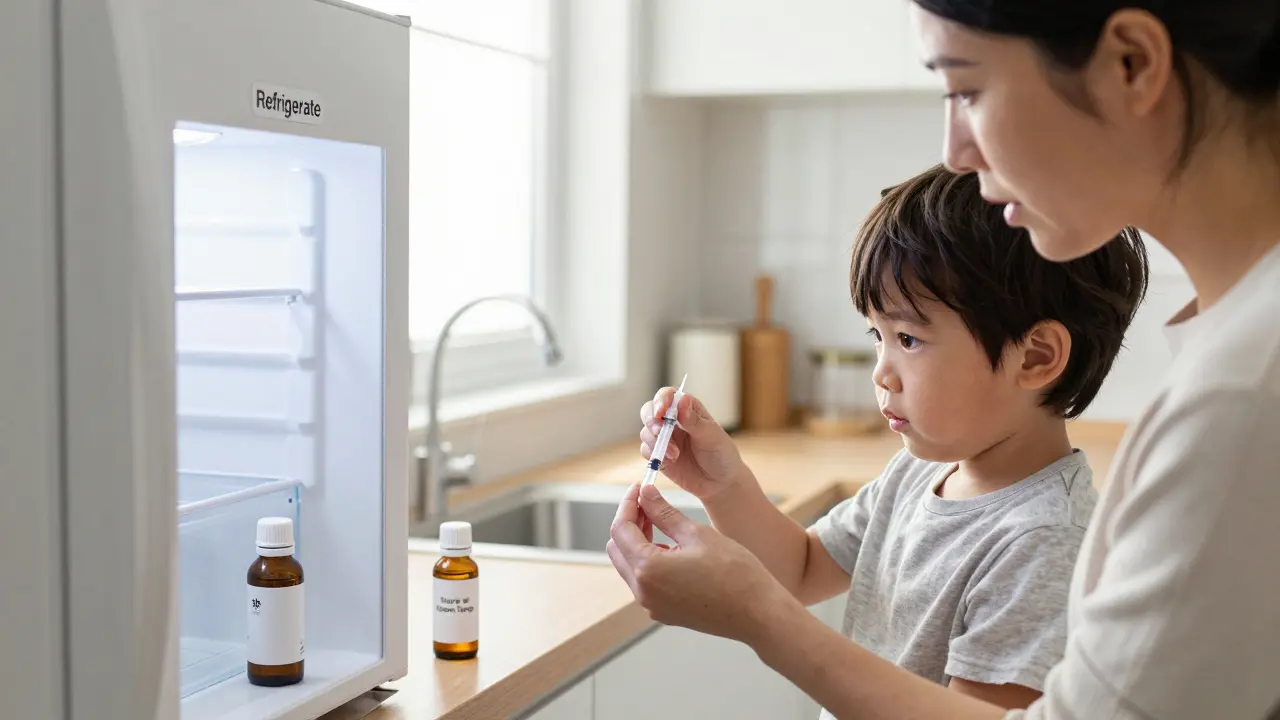
When your child is sick and needs antibiotics, the medicine often comes as a liquid suspension - a sweet-tasting, easy-to-swallow form made just for kids. But here’s the thing: how you store it can make the difference between a full recovery and a treatment that fails. Many parents don’t realize that refrigerating one antibiotic might be perfect, while doing the same to another could ruin it. And using it past its discard date? That’s not just wasteful - it’s risky.
Why Storage Matters More Than You Think
Antibiotic suspensions aren’t like pills. They’re liquids mixed with water after you buy them, and once mixed, they start to break down. If stored wrong, the medicine loses strength. That means your child might not get the full dose they need. The CDC found that improper storage contributes to 15% of antibiotic treatment failures in kids. That’s one in every seven cases where the infection doesn’t clear up because the medicine wasn’t strong enough.
It’s not just about effectiveness. If the antibiotic degrades, bacteria can survive and grow stronger. That’s how antibiotic resistance starts - and it’s one of the biggest health threats today. Proper storage keeps the medicine working as intended and helps protect future treatments for everyone.
Amoxicillin: The Most Common, But Confusing
Amoxicillin is the #1 antibiotic prescribed to children. About 1 in 3 pediatric antibiotic prescriptions are for this one. But even experts disagree on how to store it.
The Cleveland Clinic says you can keep it at room temperature (68-77°F) or in the fridge. MedlinePlus says the same thing. But here’s the catch: many pharmacies still put a sticker on the bottle that says “Refrigerate.” So what do you do?
The truth? Both are safe. Amoxicillin stays strong for 14 days whether it’s in the fridge or on the counter. But if you refrigerate it, your child might like the taste better - it’s cooler and less sweet. If they hate cold medicine, leave it out. Just make sure it’s not near the stove, window, or heater. Room temperature means 68-77°F. If your kitchen hits 80°F or higher, it’s too warm.
Amoxicillin/Clavulanate (Augmentin): Must Stay Cold
This combo medicine is the second most common pediatric antibiotic. It’s used for tougher infections like ear infections or sinusitis. But unlike plain amoxicillin, this one must be refrigerated.
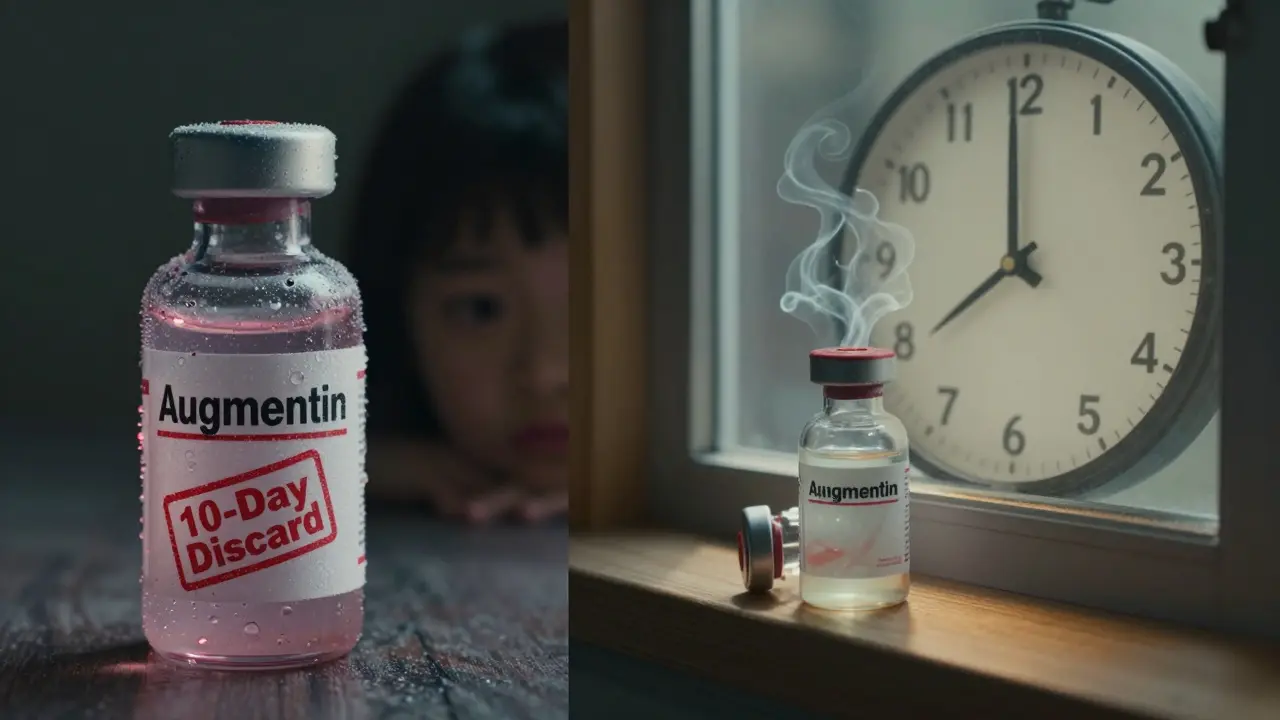
Keep it at 36-46°F (2-8°C). If you leave it out, it starts losing power after just 5 days. By day 10, it’s lost nearly 10% of its strength. The clavulanate part - the ingredient that fights resistant bacteria - breaks down fast at room temperature. That’s why the FDA and IDSA now say: discard after 10 days, even if it looks fine.
Don’t be fooled by old labels. Some pharmacies still say “14 days” for Augmentin. That’s outdated. As of 2023, the Infectious Diseases Society of America updated guidelines to reflect new data: 10 days max for this one.
Azithromycin (Zithromax): Never Refrigerate
This one’s the opposite. Azithromycin suspension gets thick and sticky when cold. Kids hate it. It’s hard to draw into the syringe, and it clings to the sides of the bottle. A 2023 taste study found refrigeration made it 37% less palatable.
Store azithromycin at room temperature only. It’s stable for 10 days. If you put it in the fridge, you’re not helping - you’re making it harder for your child to take. The same goes for clarithromycin and clindamycin. Cold = bad for these.
Other Antibiotics: What to Watch For
Here’s a quick reference for common suspensions:
- Do NOT refrigerate: Azithromycin, clarithromycin, clindamycin, sulfamethoxazole/trimethoprim (Bactrim), cefdinir
- Must refrigerate: Amoxicillin/clavulanate (Augmentin), cefuroxime, cefdinir (if labeled that way)
- Either way: Amoxicillin (14 days at room temp or fridge)
Always check the label. If it says “Refrigerate,” do it. If it says “Store at room temperature,” leave it out. If you’re unsure, call the pharmacy. They’re required to give you clear instructions.
When to Throw It Out
Never use antibiotics past their discard date. Even if it looks normal. Even if you only gave half the bottle. Even if your child didn’t finish the full course.
Here’s the hard truth: after the discard date, the medicine doesn’t just weaken - it becomes unpredictable. Some batches may still work. Others might be too weak to fight the infection. And there’s no way to tell without a lab.
Most suspensions last:
- 14 days: Amoxicillin, cephalexin
- 10 days: Amoxicillin/clavulanate, azithromycin
- 5-7 days: Some others (check the label)
Write the discard date on the bottle with a Sharpie. Or use a sticker. The CDC found that using a visible discard sticker cuts misuse by 42%.
Signs Your Medicine Has Gone Bad
Even if it’s within the date, watch for these red flags:
- Change in color - yellow, brown, or cloudy when it used to be clear
- Strange smell - sour, rancid, or chemical
- Too thick or too watery - especially if it’s supposed to be smooth
- Sediment that doesn’t mix back in - shake hard and if chunks stay, toss it
- Taste change - if your child says it tastes “off,” believe them
One parent on Reddit said her child refused the medicine because it tasted “like metal.” She threw it out. The next dose was fine. She didn’t know it had degraded - but her child did.

Storage Tips That Actually Work
Here’s what real parents and pharmacists recommend:
- Use a dedicated spot. Pick one shelf in the fridge (for refrigerated meds) or a cabinet away from sunlight and heat. Don’t store it in the bathroom - humidity ruins medicine.
- Label the bottle. Write the start date and discard date in big letters. Add a note: “Do not refrigerate” if needed.
- Use a reminder app. The CDC’s free “MedSafe” app sends text alerts when it’s time to toss the bottle.
- Keep it out of reach. All medications should be stored “up and away” - locked cabinets or high shelves. Over 60,000 kids under 5 are treated each year for accidental poisoning.
- Don’t guess. If you’re unsure, call your pharmacist. They have access to the manufacturer’s stability data.
What Happens If You Get It Wrong?
Using degraded antibiotics doesn’t always cause immediate harm. But it does three dangerous things:
- It lets the infection keep growing - your child might get sicker.
- It forces doctors to prescribe stronger, more expensive antibiotics later.
- It helps create superbugs that don’t respond to any antibiotics.
Dr. Jessica Smith, a pediatric pharmacist, says: “The single most common error I see is parents continuing to use antibiotics beyond the discard timeframe. That accounts for 27% of treatment failures we observe.”
And in places without reliable electricity - like rural areas - the problem is worse. WHO reports 8.2% higher treatment failure rates because refrigerated meds can’t be kept cold.
Final Rule: When in Doubt, Ask
There’s no single rule that fits every antibiotic. Labels vary. Pharmacies differ. Guidelines change.
Your best move? Always check the pharmacy label. If it says “Refrigerate,” do it. If it says “Store at room temperature,” don’t put it in the fridge. If it says nothing, call the pharmacy. Ask: “Is this supposed to be refrigerated? And when do I throw it out?”
And if you’re still confused? Keep the bottle. Write down the name, the date you mixed it, and the instructions. Then call your child’s doctor. They’ve seen this before. They’ll help.
Patrick Jarillon
February 8, 2026 AT 19:13Let me tell you something the FDA doesn't want you to know-antibiotic suspensions are a big pharma scam. They make you think refrigeration matters but really it's all about shelf life profits. I've been collecting vials from 2018 and they still work fine. The 'discard date' is just a marketing tactic to sell more bottles. My kid took amoxicillin from a 5-year-old bottle last winter and beat pneumonia without even finishing it. They're lying to you about degradation. The real threat? Corporate greed, not medicine.
Gouris Patnaik
February 10, 2026 AT 11:06Western medicine is built on illusion. You think storing medicine correctly prevents resistance? No. Resistance comes from overprescribing, not storage. In India, we give antibiotics without prescriptions and children recover. Why? Because the body has wisdom. Modern science confuses chemistry with healing. Your child doesn't need a fridge. They need rest, turmeric, and silence. You're treating symptoms, not the soul.
Jesse Lord
February 11, 2026 AT 04:09Man I wish I read this before my last kid's ear infection. I refrigerated azithromycin because the label said so and she screamed every time I gave it to her. Turns out I made it worse. We called the pharmacy and they laughed and said 'Dude it's supposed to be room temp.' She took it like candy after we moved it to the cabinet. Thanks for the clarity. This is the kind of info that actually saves days of crying.
Paula Sa
February 13, 2026 AT 00:17I really appreciate how this post breaks down the science without being scary. I used to panic every time the pharmacist handed me a new bottle. Now I just write the discard date on the cap with a Sharpie and put it on the counter next to the cereal. It’s such a small thing but it gives me peace. My daughter’s been on three different antibiotics this year and we haven’t had a single issue since I started doing this. You’re not just helping kids-you’re helping parents breathe.
Sarah B
February 13, 2026 AT 20:39Why are we letting pharmacies dictate how we store medicine? The CDC says one thing but the manufacturer says another. Who even are these people? I checked the Augmentin bottle I had and the label said 14 days. The pharmacy said 10. I went with 10. I don't trust systems anymore. If you're not checking the manufacturer's website yourself you're just following noise.
Tola Adedipe
February 14, 2026 AT 11:51Wait so you're telling me I've been ruining my kid's treatment for two years because I refrigerated clindamycin? I thought cold meant better. That's insane. My daughter nearly threw up every time I gave it to her. I thought it was the taste. Turns out it was the texture from the fridge. We switched to room temp and she drank it like juice. This changes everything. Thank you for the data. I'm telling every mom in my group chat.
Heather Burrows
February 16, 2026 AT 10:18It's tragic how much fear and confusion parents are forced to navigate just to keep their children alive. We're not trained pharmacists. We're not given manuals. We're told to trust labels that change every year. And then we're blamed when things go wrong. This isn't healthcare. It's a minefield disguised as a system. And the real crime? No one teaches us how to read between the lines. We're left alone with a syringe and a prayer.
Marcus Jackson
February 17, 2026 AT 01:23Amoxicillin can go either way? Yeah right. I've been keeping mine at room temp for years. No issues. The fridge thing is a myth pushed by pharmacies to make you buy new bottles. My kid's had five courses. All fine. You're overcomplicating this. Just don't leave it in the sun. Done.
Natasha Bhala
February 18, 2026 AT 20:38Love this so much. I use the medsafe app now and it sends me a text 2 days before discard. I used to just forget and then feel guilty. Now I toss it without stress. My 3yo doesn't even notice when I switch bottles. It's the little things that make parenting feel less chaotic. Thanks for making it simple.
Savannah Edwards
February 19, 2026 AT 22:55I come from a family where medicine was stored in a wooden box in the attic, labeled with candle wax and a prayer. My grandmother never refrigerated anything. She said heat and light were the real enemies, not temperature. And you know what? All seven of her grandchildren made it through childhood without a single treatment failure. I think we've lost touch with instinct. The science is helpful, yes, but don't forget that humans have been keeping medicine safe for millennia without QR codes or apps. Sometimes the oldest wisdom is the quietest one.
Mayank Dobhal
February 21, 2026 AT 18:14My kid threw up on Augmentin after 7 days. We didn't know it was expired. The doctor said 'maybe the medicine went bad.' We thought it was the illness. Turns out it was the fridge. We left it out. Next dose? No puke. Just a happy kid. Don't overthink it. Test it. If it tastes weird, toss it. Your gut knows before your brain does.
Ashley Hutchins
February 21, 2026 AT 19:44I'm so tired of people acting like this is complicated. You have a bottle. You have a date. You have a fridge. If it says refrigerate use the fridge. If it says room temp leave it out. If you're confused call the pharmacy. That's it. Stop overanalyzing. Stop reading blogs. Stop comparing notes. Just follow the damn label. You're not a scientist. You're a parent. Do the thing.
Lakisha Sarbah
February 22, 2026 AT 22:35Just wanted to say thank you. I was so stressed about getting this right. I thought I was failing as a mom because I kept forgetting the dates. Now I write them on the bottle with a highlighter. My 2yo doesn't care if it's cold or not. She just wants it done. And honestly? So do I. This made my life easier.