

When someone is having a severe allergic reaction, every second counts. Anaphylaxis can turn a mild itch into a life-threatening emergency in under five minutes. If you or someone you care about has a history of serious allergies, knowing how to use an epinephrine auto-injector isn’t just helpful-it’s essential. This isn’t about memorizing steps for a test. It’s about being ready when panic sets in and your brain goes blank. The good news? With the right practice, using an auto-injector becomes second nature.
What Is an Epinephrine Auto-Injector?
An epinephrine auto-injector is a small, handheld device that delivers a single, pre-measured dose of epinephrine (also called adrenaline) directly into the muscle. It’s designed for people who are at risk of anaphylaxis-often due to food allergies, insect stings, or certain medications. Brands like EpiPen, a widely used epinephrine auto-injector that delivers 0.15mg or 0.3mg of epinephrine via spring-loaded needle, Auvi-Q, a voice-guided auto-injector with built-in instructions, and Adrenaclick, a lower-cost manual device requiring two-step activation are common in the U.S. In 2023, the FDA approved Neffy, a needle-free nasal spray alternative, offering another option for those afraid of needles.
Epinephrine works fast. It tightens blood vessels to raise dropping blood pressure, opens airways to ease breathing, and boosts heart function. Without it, anaphylaxis can lead to cardiac arrest or suffocation. Studies show that giving epinephrine within 5-15 minutes of symptom onset cuts the risk of death by 75%. Delaying it-even for antihistamines or inhalers-can make things worse.
Recognizing Anaphylaxis
You don’t need to wait for all symptoms to appear. Anaphylaxis can start mild and spiral quickly. Watch for any combination of these signs:
- Hives, swelling of lips, tongue, or throat
- Wheezing, trouble breathing, or feeling like your throat is closing
- Dizziness, fainting, or sudden weakness
- Nausea, vomiting, or abdominal pain
- Rapid or weak pulse
- Feeling of doom or extreme anxiety
It’s not always obvious. A child might just start crying uncontrollably or clutch their throat. An adult might suddenly feel lightheaded after eating. If you’re unsure, and the person has a known allergy, it’s better to use the injector than to wait. Mistakenly giving epinephrine when it’s not needed is far safer than not giving it when it is.
Step-by-Step: How to Use an Epinephrine Auto-Injector
Every device is slightly different, but the core steps are the same. Here’s how to do it right.
- Remove the safety cap. Most injectors have a blue or gray cap on one end. Don’t twist or pull it off-you need to pull it straight out. For EpiPen, it’s the blue end. For Auvi-Q, it’s the gray end. If you’re holding the device upside down, you’ll miss the cap.
- Position the injector. Hold it firmly in your fist. Place the black tip against the outer thigh. You can inject through clothing if needed. No need to remove pants. The outer thigh is the best spot because it’s thick, accessible, and has good blood flow.
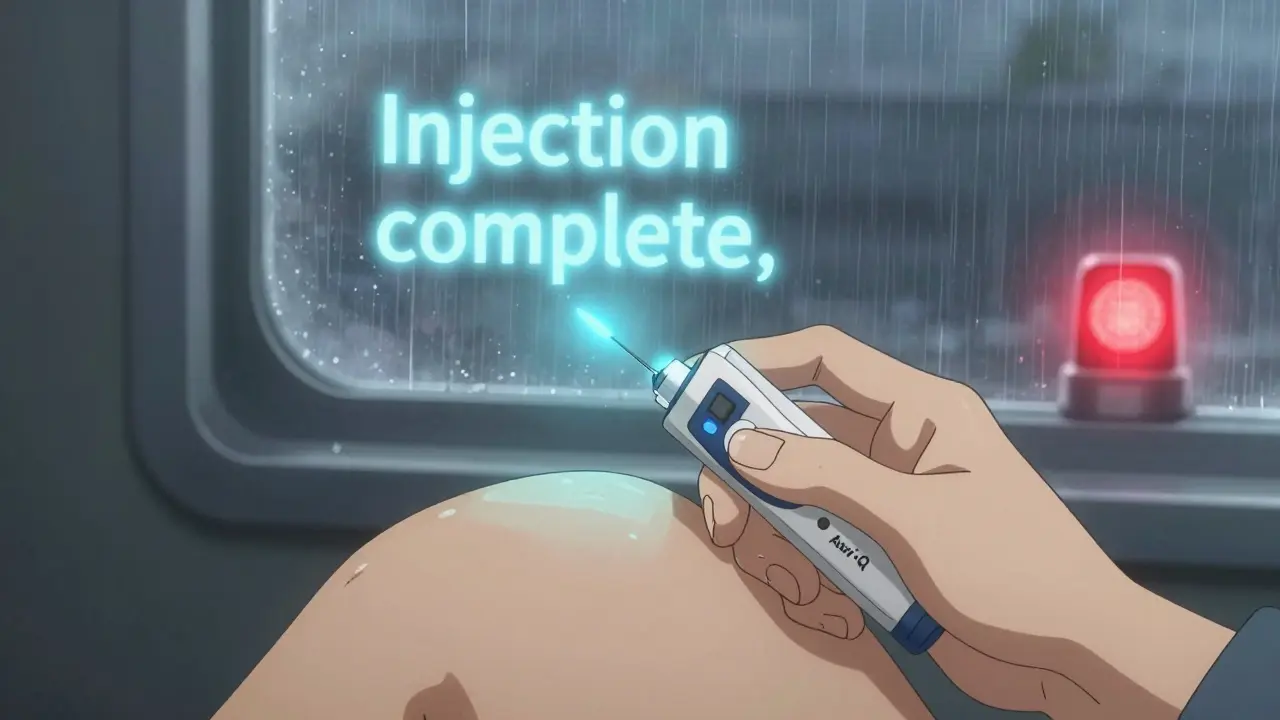
- Push hard and hold. Press the injector firmly against the thigh until you hear a click. Keep it pressed in place for 3 full seconds. Don’t let go early. The device needs that time to deliver the full dose. For Auvi-Q, you’ll hear a voice say, “Injection complete.” For EpiPen, you’ll feel a slight jolt and see the needle retract.
- Remove and massage. Take the device away and rub the injection site for 10 seconds. This helps the medicine absorb faster.
- Call 911 immediately. Even if the person feels better, they still need emergency care. Anaphylaxis can come back hours later (called a biphasic reaction). Never skip this step.
For children, hold their leg steady while injecting. Don’t let them move. If you’re alone and the person collapses, inject first, then call for help. If someone else is nearby, have them call 911 while you administer the shot.
What to Do After the Injection
After using the injector, the person should lie flat on their back with legs raised. If they’re vomiting or having trouble breathing, turn them onto their side. Do not let them stand or walk. Even if they feel fine, they must be monitored in a hospital for at least 4-6 hours.
Keep the used injector. Paramedics will need to know what was given and when. Bring the empty device with you to the ER.
Some people need a second dose. If symptoms don’t improve-or get worse-after 5-10 minutes, use a second injector if available. Many people don’t know this is an option. It’s not dangerous. Epinephrine’s side effects (like a racing heart or shaking) are temporary and far less risky than untreated anaphylaxis.
Common Mistakes and How to Avoid Them
Real-world data shows that nearly 60% of auto-injector uses are done incorrectly. Here are the top errors and how to fix them:
- Not removing the safety cap. This is the #1 mistake. Practice with a trainer device until you can remove the cap blindfolded.
- Injecting into the wrong spot. Avoid the buttocks, abdomen, or arms. The outer thigh is the only recommended site.
- Not holding long enough. Most people release after 1-2 seconds. You need 3 full seconds. Count out loud: “One-Mississippi, two-Mississippi, three-Mississippi.”
- Forgetting to call 911. People think, “I used the shot, I’m fine.” That’s a deadly myth. Emergency responders need to be on the way.
- Storing it wrong. Don’t leave it in a hot car, in direct sunlight, or in the fridge. Keep it at room temperature (59-86°F). Check the expiration date every month.
Many people report accidentally triggering their injector by gripping it too tightly. Practice with a trainer device (often free from pharmacies) to get comfortable with the motion. Keep it in a secure case-not loose in a purse or backpack.
Device Comparison: EpiPen vs. Auvi-Q vs. Adrenaclick vs. Neffy
Not all auto-injectors are the same. Here’s how they stack up:
| Device | Dose | Activation | Special Features | Cost (Cash Price) | Best For |
|---|---|---|---|---|---|
| EpiPen | 0.15mg or 0.3mg | Spring-loaded, one-step | Simple, widely recognized | $679 | Most users, schools, first responders |
| Auvi-Q | 0.15mg or 0.3mg | Spring-loaded, one-step | Voice instructions, retractable needle | $4,229 | High-stress situations, caregivers who panic |
| Adrenaclick | 0.15mg or 0.3mg | Two-step manual | Lowest cost, no electronics | $195 | Cost-sensitive users, insurance gaps |
| Neffy | 0.3mg | Nasal spray | Needle-free, FDA-approved 2023 | $350-$500 | Needle-averse users, children |
Most people choose EpiPen because it’s the most familiar. But if you’re anxious or forget steps under pressure, Auvi-Q’s voice prompts can be lifesaving. Adrenaclick is cheaper but requires more steps. Neffy is new and promising, but it’s harder to use correctly-32% of people fail to spray properly in simulations.
Training and Practice
Just reading this guide isn’t enough. You need to practice. Use a trainer device (no needle, no medicine) to simulate the real thing. Most pharmacies give them out for free. Do it with your family, your child’s teacher, your coworker. Make it a habit.
Check the expiration date every month. Epinephrine loses potency over time. Replace it before it expires. Keep one at home, one at school, one in your bag. If you’re traveling, carry two.
Teach kids how to use theirs by age 6-7. Let them practice on a stuffed animal. Make it normal, not scary. Schools in 47 U.S. states are required to have epinephrine on hand-but only 28 states require staff training. Ask your school if they’ve trained their nurses and aides.

When to Get Help
After using epinephrine, you must go to the ER. Even if you feel fine. The reaction can return. You need monitoring. If you’re alone and collapse after injecting, call 911 before you lose consciousness. If you’re helping someone, stay with them until help arrives.
Don’t rely on antihistamines like Benadryl. They help with rashes and itching-but they won’t stop airway swelling or low blood pressure. Epinephrine is the only thing that can save a life during anaphylaxis.
Final Thoughts
Anaphylaxis is terrifying. But you don’t have to be helpless. Epinephrine auto-injectors work. They’ve saved millions of lives. The problem isn’t the device-it’s the fear, the hesitation, the lack of practice.
Practice. Carry two. Know the signs. Call 911. Teach others. That’s the entire plan. There’s no magic trick. Just action, quickly and confidently.
If you’re reading this because someone you love has a severe allergy, you’re already doing the right thing. Now go get a trainer device. Practice today. Make sure your child’s teacher knows how to use one. Write the steps on a sticky note and put it on the fridge. This isn’t just about medicine. It’s about being ready when it matters most.
Can I use an epinephrine auto-injector on myself?
Yes. If you’re experiencing symptoms of anaphylaxis and you’re conscious, you should inject yourself immediately. Aim for the outer thigh, remove the safety cap, and press firmly for 3 seconds. Even if you’re scared, do it. Delaying can be fatal.
What if I accidentally inject myself in the wrong place?
If you inject into the hand, finger, or foot, you still need to call 911. Epinephrine can cause serious tissue damage if injected into small areas, but the risk of death from untreated anaphylaxis is far greater. Use the injector wherever you can-then get emergency help.
Do I need a prescription for an epinephrine auto-injector?
Yes. In the U.S., epinephrine auto-injectors require a prescription from a doctor. If you have a history of severe allergies, talk to an allergist. They’ll determine your risk and prescribe the right dose based on your weight.
Can I use an expired epinephrine auto-injector?
If it’s your only option during an emergency, yes-use it. Epinephrine doesn’t suddenly become dangerous after expiration. It just loses strength. A 2021 study found that expired EpiPens still delivered 80-90% of their original dose up to 2 years past expiration. But don’t rely on it. Replace it before it expires.
Can I reuse an epinephrine auto-injector?
No. Auto-injectors are single-use only. After activation, the needle retracts or locks. Do not try to refill or reuse it. Always carry two devices in case a second dose is needed.
How do I store my epinephrine auto-injector?
Keep it at room temperature (59-86°F), away from direct sunlight and extreme heat or cold. Don’t store it in your car, near a window, or in the fridge. Check the color of the liquid inside-it should be clear. If it’s brown or cloudy, replace it immediately.
Is Neffy better than EpiPen?
Neffy is a good alternative for people afraid of needles, but it’s not universally better. In clinical trials, it worked in 81% of severe reactions, but 32% of users failed to spray correctly during simulations. EpiPen has decades of real-world use and is easier to use correctly. The best device is the one you’ll use without hesitation.
Next Steps
Right now, go to your pharmacy and ask for a trainer device. Practice until you can do it without thinking. Show your family how to use it. Check your expiration dates. Make sure your child’s school has a spare and knows how to use it. If you’re traveling, carry two.
Don’t wait for an emergency to learn this. The time to prepare is today. Because when minutes count, you won’t have time to read a guide. You’ll need to act. And you will.
Juan Reibelo
January 23, 2026 AT 13:48I’ve carried two EpiPens in my wallet for seven years now-because I once watched my brother turn blue in a diner, and no one knew what to do.
Practice with the trainer. Every. Single. Month.
It’s not paranoia. It’s preparation.
And yes, I’ve accidentally triggered mine once-while reaching for my keys. Still better than the alternative.
Sawyer Vitela
January 24, 2026 AT 01:2660% use it wrong? That’s because people treat it like a magic bullet, not a tool.
Epinephrine doesn’t fix allergies. It buys time.
And no, Neffy isn’t ‘better’-it’s a novelty with 32% failure rate in sims.
Stick with EpiPen. It’s been proven for decades.
Stop chasing shiny new gadgets and learn the basics.
Tiffany Wagner
January 25, 2026 AT 23:20I used to be terrified of needles but after my daughter had her first reaction I got the trainer and practiced every night before bed.
Now I can do it blindfolded and I taught her to give herself a high five after each practice.
It’s not scary anymore. It’s just part of our routine.
Thank you for writing this. It’s the kind of thing I wish I’d found sooner.
Chloe Hadland
January 27, 2026 AT 11:44This is the kind of post that makes me believe people still care.
Thank you for not sugarcoating it.
So many of us live with this fear every day.
Just knowing someone else gets it helps.
Amelia Williams
January 29, 2026 AT 03:59My 8-year-old got her first EpiPen last year and we turned it into a game-we call it ‘Superhero Mode’.
We practice on stuffed animals, we draw pictures of it, we even made a little certificate for when she gets it right.
She’s not scared anymore. She’s proud.
And guess what? Her whole class knows how to use one now because she showed them during show-and-tell.
Small wins matter.
Start today. Don’t wait for the emergency to teach you.
Viola Li
January 29, 2026 AT 07:28Why is this even a thing? Why do we rely on a single drug delivered by a plastic tube that could fail?
Big Pharma controls the market.
EpiPen costs $700? That’s a scam.
And Neffy? Probably just another patented gimmick to keep you buying.
They don’t want you cured. They want you dependent.
Question the system. Don’t just trust the device.
Dolores Rider
January 29, 2026 AT 15:56Okay but what if the injector is tampered with? 😳
I heard a story on Reddit about someone’s EpiPen being switched with a trainer in a school cafeteria and the kid died because they thought it worked.
And what if the expiration date is fake? What if the batch was recalled but the pharmacy didn’t tell you?
I check mine every week. I even take a photo of the liquid inside.
It’s not paranoia. It’s survival.
And don’t even get me started on how the FDA approves these things... 😒
Trust no one. Not even the instructions.
John McGuirk
January 29, 2026 AT 19:16They say ‘call 911’ like it’s that simple.
What if you’re in the middle of nowhere?
What if the ambulance takes 45 minutes?
What if the paramedics don’t know what to do?
My cousin used his EpiPen and waited 20 minutes for help.
He didn’t make it.
So yeah. Practice. But also... be ready to fight for your life alone.
They don’t teach you that part.
Michael Camilleri
January 31, 2026 AT 01:32You think this is about medicine?
No.
This is about control.
They give you a device so you feel safe.
So you stop asking why your child is allergic.
So you stop questioning the food industry.
So you stop demanding real change.
Epinephrine is a Band-Aid on a bullet wound.
It doesn’t fix the system.
It just lets you keep living inside it.
Wake up.
It’s not about injecting yourself.
It’s about realizing you’ve been sold a lie.
Darren Links
February 1, 2026 AT 06:41Canada’s got it right. We don’t need prescriptions for epinephrine.
Why does the US make it so hard?
It’s not about safety.
It’s about profit.
And don’t even get me started on how EpiPen’s price jumped 500% while they kept the same damn vial.
It’s a national disgrace.
And now they’re pushing Neffy like it’s the future?
Same playbook.
Same greed.
Same people dying because they couldn’t afford to be prepared.
Kevin Waters
February 1, 2026 AT 12:30Just wanted to add something practical-my local pharmacy gives free trainer pens if you ask.
They also have a little card you can print out with the steps.
I keep one taped to my fridge and one in my car.
My wife and I do a 30-second drill every Sunday morning while we drink coffee.
It’s become normal.
And if you’re worried about your kid’s school? Ask for a copy of their anaphylaxis plan.
Most schools have one.
They just don’t advertise it.
Be the person who asks.
You’ll be surprised how many people are relieved you did.
Gina Beard
February 2, 2026 AT 11:20Epinephrine doesn’t cure. It delays.
So what’s the endgame?
Are we just buying time until the next reaction?
Or is the real solution to stop creating allergens in the first place?
Maybe we should be asking why the food supply is so toxic.
Not just how to inject faster.