
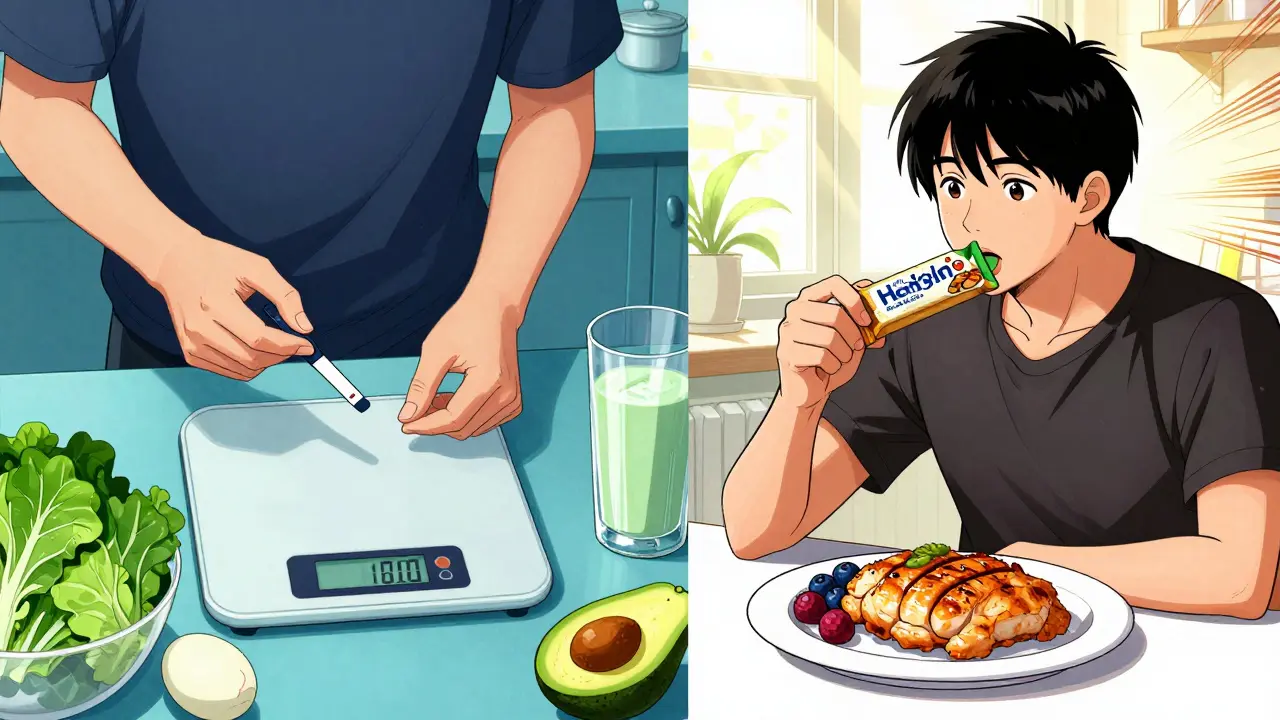
When you’re trying to lose weight and tired of counting calories, low-carb diets like keto and Atkins sound like a miracle. Cut out the bread, pasta, and sugar, and the pounds just melt off-right? It’s not that simple. Both diets promise fast results, but they work in very different ways. And if you don’t pick the right one for your lifestyle, you’ll burn out fast-or worse, regain everything you lost.
What’s the Real Difference Between Keto and Atkins?
The keto diet was created in the 1920s to treat seizures in children. It’s not just about eating less carbs-it’s about forcing your body into a state called ketosis, where it burns fat instead of sugar for fuel. To do that, you need to keep carbs under 50 grams a day, get 75-90% of your calories from fat, and limit protein. Too much protein? Your body turns it into glucose, and you kick yourself out of ketosis.
Atkins, on the other hand, was designed as a step-by-step plan to help people lose weight and keep it off. It starts strict-just 20 grams of net carbs a day in Phase 1-but slowly lets you add carbs back in over time. By Phase 4, you could be eating up to 100 grams of carbs daily and still maintain your weight. There’s no need to track fat percentages. Protein? You can eat as much as you want.
So here’s the core difference: Keto is a permanent metabolic shift. Atkins is a flexible eating plan that ends with you finding your personal carb tolerance.
Which One Gets You Faster Results?
In the first 3 to 6 months, both diets deliver strong weight loss. A 2014 study showed people on a keto diet lost an average of 20 kg (44 lbs) in a year. A 2013 study on Atkins showed similar drops in weight and improved blood sugar levels in people with type 2 diabetes.
But here’s what most people don’t tell you: after 12 months, the difference disappears. A 2022 study in the American Journal of Clinical Nutrition found that while keto led to more weight loss at 6 months, by 24 months, both keto and moderate-carb diets had lost about the same amount of weight. That’s because people stop sticking to the rules.
Keto’s advantage is that it keeps your metabolism stable. Many diets cause your resting metabolic rate to drop as you lose weight, making it harder to keep losing. Keto doesn’t do that as much. But it’s also harder to stick to.
The Keto Flu and Why People Quit
If you’ve ever tried keto, you’ve probably heard of the “keto flu.” It’s not a real flu-it’s your body adjusting. When you cut carbs, your body flushes out water and salt. That causes headaches, fatigue, brain fog, and irritability. Around 70-80% of new keto dieters feel this way, usually for 1-2 weeks.
On Reddit, users say things like: “I lost 50 pounds, but those first two weeks were hell.” Others say they gave up because they couldn’t eat fruit, yogurt, or even a single sweet potato. And then there’s the cost. Blood ketone strips can run $40-$60 a month. Apps like Carb Manager help, but they don’t fix the hunger or cravings.
Atkins doesn’t have a “flu.” The first two weeks are strict, but after that, you get more food options. No one’s telling you to avoid chicken thighs or eggs. You can eat cheese, bacon, avocados, and even some berries. The phased approach makes it feel less like punishment and more like progress.

Processed Foods: Keto’s No-Go vs. Atkins’ Convenience
Keto purists say you should eat whole foods only: meat, eggs, leafy greens, nuts, olive oil. No protein bars. No “keto” cookies. No fake cheese.
Atkins? They sell them. The Atkins brand has over 200 products-shakes, bars, frozen meals, even chocolate bars. They’re labeled “low-carb,” but many are full of sugar alcohols, artificial sweeteners, and preservatives. On Trustpilot, Atkins products average 3.8 out of 5 stars. People love the convenience. Others say, “I lost weight, but my digestion went to hell.”
That’s not just about food quality. It’s about sustainability. If your diet relies on packaged snacks, what happens when you travel? When you’re busy? When the store’s out of stock? Keto forces you to cook. Atkins lets you buy your way through.
Who Wins for Long-Term Weight Loss?
The Mayo Clinic says it plainly: over the long term, low-carb diets like Atkins aren’t more effective than any other weight-loss plan. That’s because adherence is everything.
Here’s the data: 68% of keto dieters lose weight in the first 3 months. But only 35% are still on it after a year. For Atkins, 62% lose weight early, and 48% stick with it after 12 months.
Why? Because Atkins ends with freedom. Phase 4 isn’t a failure-it’s the goal. You learn how many carbs your body can handle without gaining weight. Maybe it’s 50 grams. Maybe it’s 80. You test it. You adjust. You live.
Keto doesn’t have that. If you eat 55 grams of carbs one day, you’re out of ketosis. You have to start over. For many, that’s exhausting.
Who Should Choose Which Diet?
Choose keto if:
- You want fast, dramatic results in the first 3-6 months
- You’re okay with strict rules and meal prep
- You have insulin resistance or type 2 diabetes and want to stabilize blood sugar
- You don’t mind avoiding fruit, grains, and most dairy
Choose Atkins if:
- You want a clear roadmap-not just a list of “eat this, avoid that”
- You like structure but need flexibility over time
- You want to eventually eat carbs again-without gaining weight
- You’re okay with occasional processed low-carb foods for convenience
Neither diet is right for everyone. If you hate counting grams, hate reading labels, or love whole grains, both diets will feel like a prison.

What Experts Really Think
Dr. David Ludwig from Harvard says keto can produce “impressive short-term weight loss,” but the extreme restriction makes it hard to keep up. Dr. Walter Willett, former chair of Harvard’s nutrition department, says Atkins’ phased approach offers a “more practical path to sustainable weight management.”
But there’s a warning: high saturated fat intake-common in both diets if you’re eating a lot of butter, cheese, and fatty meats-can raise LDL cholesterol in some people. That’s why the American Diabetes Association says low-carb diets are effective for short-term weight loss and blood sugar control, but long-term safety data is still limited.
And then there’s the supplement industry. The FTC has cracked down on keto supplement companies making fake claims. No pill, powder, or shake can replace real food.
Real People, Real Results
One woman from Cape Town, 42, tried keto for 4 months. She lost 14 kg. But she says, “I couldn’t eat my daughter’s birthday cake. I missed my morning oats. I felt like I was always hungry.” She switched to Atkins 40. Now, she eats 60 grams of carbs a day-mostly from vegetables, berries, and a little whole grain bread. She’s kept off the weight for 18 months.
Another man, 37, stuck with keto for a year. He says, “I didn’t feel hungry. My energy was steady. My blood sugar stayed normal.” But he had to cook every meal. He bought a scale. He tracked every bite. He still does. He says, “It’s not a diet anymore. It’s my life.”
There’s no one-size-fits-all. But there is a better fit for you.
What Comes After the Diet?
The biggest mistake people make? Thinking the diet is the end goal. It’s not. It’s the training wheels.
Both keto and Atkins can teach you how carbs affect your hunger, energy, and cravings. Once you know that, you don’t need the rules anymore. You can choose to eat less sugar. Less bread. Less processed junk. Not because you’re forced to-but because you’ve seen how it makes you feel.
That’s real weight loss. Not the kind you lose in 6 months. The kind you keep for life.
Start with what you can stick to. Not what looks fastest. Not what’s trending. What you’ll still be doing in 12 months.
LIZETH DE PACHECO
January 2, 2026 AT 16:49I tried keto for 3 months and lost 18 lbs, but I was miserable. No fruit, no oatmeal, no joy. Switched to Atkins Phase 3 and now I eat berries, sweet potatoes, and even the occasional dark chocolate. I haven’t regained a pound in 2 years. It’s not about being perfect-it’s about being consistent.
jaspreet sandhu
January 4, 2026 AT 04:03Keto is for people who like to suffer. Atkins is for people who want to live. You don’t need to be in ketosis to lose weight. You just need to stop eating junk. Simple. No science needed. Just eat less sugar and you’ll be fine. Stop overcomplicating food.
Olukayode Oguntulu
January 4, 2026 AT 11:23Let’s be real-the entire low-carb industry is a capitalist fever dream. We’ve been conditioned to believe that metabolic magic exists in grams of net carbs, when in reality, weight loss is just caloric deficit dressed up in keto leggings and MCT oil. The body doesn’t care if you’re in ketosis or not-it cares if you’re eating less than you burn. The rest is marketing.
And yet, here we are, arguing over whether 55g or 60g of carbs is the cosmic threshold for divine fat-burning. We’ve turned nutrition into a cult. Ketosis is not enlightenment. It’s biochemistry.
Atkins didn’t invent flexibility; it just admitted that humans aren’t robots. The real miracle isn’t fat adaptation-it’s the human capacity to adapt to boredom, cravings, and birthday cakes without collapsing into existential despair.
Meanwhile, the supplement industry is selling ketone salts like they’re the Holy Grail. Buy a bottle, drink it, and still feel hungry. The FTC should shut them all down. But they won’t. Because profit > science > truth.
What we need isn’t another diet. We need to unlearn the idea that food is a problem to be solved. It’s fuel. It’s culture. It’s love. Stop tracking. Start living.
Todd Nickel
January 5, 2026 AT 23:40Interesting breakdown, but I think the real issue nobody talks about is the psychological toll of constant monitoring. Keto requires you to become a nutritionist overnight-weighing every bite, checking labels for hidden carbs, avoiding ‘keto-friendly’ products that are just sugar alcohols in disguise. It’s not sustainable for someone with a full-time job and kids.
Atkins, by contrast, gives you milestones. You’re not failing if you eat 70g of carbs on day 150-you’re progressing. That’s huge for mental health. The phased approach is essentially behavioral therapy disguised as a diet.
Also, the claim that keto stabilizes metabolism is misleading. Yes, it prevents the drop in RMR better than calorie-restricted diets, but only if you’re eating enough fat and not overdoing protein. Most people under-eat fat and overeat protein, then wonder why they’re not losing weight. The diet isn’t broken-they’re just doing it wrong.
And the keto flu? It’s real. I had a week of brain fog so bad I missed a work deadline. I didn’t know it was dehydration and electrolytes until I started drinking broth. That’s not ‘just adaptation’-that’s a physiological shock. Why not ease into it?
Finally, the cost. Ketone strips are a scam. You don’t need to know your blood ketones to be in ketosis. Urine strips are garbage after the first week. Breath meters? Expensive. The truth? If you’re not eating carbs, you’re likely in ketosis. Stop spending $50/month on a placebo.
Atkins doesn’t require you to buy into the cult. You can eat chicken thighs, avocado, and bacon without a scale. That’s why it lasts.
Kristen Russell
January 7, 2026 AT 15:10Atkins won. No contest. Keto is for extremists. Atkins is for adults.
Bobby Collins
January 8, 2026 AT 11:32Did you know the FDA doesn’t regulate keto supplements? I read this one guy got hospitalized because he took ‘ketone boosters’ and his blood pH dropped to 7.0. That’s acidosis. People think it’s magic, but it’s just chemistry gone wrong. And the companies? They don’t care. They’re making bank while you’re sick.
Also, why is everyone obsessed with ketosis? It’s not a superpower. It’s just your body eating fat because you starved it of carbs. Kinda like fasting. But way more expensive.
Layla Anna
January 10, 2026 AT 06:51I’m from the Midwest and I used to eat biscuits and gravy every Sunday… now I eat bacon and eggs with avocado and I’m happier 😊 I didn’t even miss the carbs after a few weeks. Atkins let me slowly add back things I loved without feeling guilty. No need to be perfect. Just better. 💚
Heather Josey
January 10, 2026 AT 16:11Thank you for this balanced perspective. Many articles paint keto as the only ‘real’ low-carb option, but the data clearly shows sustainability matters more than metabolic state. The fact that 48% of Atkins followers maintain their weight after a year is more impressive than keto’s initial speed. Long-term health isn’t about hitting ketosis-it’s about building habits that last.
Also, the point about processed low-carb foods is critical. Convenience shouldn’t come at the cost of gut health. I’ve seen too many people trade sugar for sugar alcohols and end up with IBS. Whole foods first, always.
Donna Peplinskie
January 11, 2026 AT 15:09As someone who’s helped dozens of friends navigate diets, I always say: pick the one that lets you keep the things you love. One friend gave up keto because she couldn’t have her morning yogurt with berries. Another stuck with Atkins because she could add back fruit slowly. It’s not about the diet-it’s about your relationship with food. Be kind to yourself. 🌱
Alex Warden
January 12, 2026 AT 18:26Keto is a cult. Atkins is a plan. One makes you a slave to the scale. The other makes you free. End of story.
Lee M
January 14, 2026 AT 05:26It’s funny how people treat keto like a religious experience. Ketosis isn’t a spiritual state-it’s a survival mechanism. Your body’s running on backup fuel because you starved it. That’s not enlightenment. That’s evolution. And Atkins? It’s just a smarter version of the same thing. It acknowledges human nature. We crave variety. We crave freedom. Keto denies that. Atkins accommodates it.
Also, the whole ‘keto flu’ thing? That’s your body detoxing from sugar addiction. You’re not sick-you’re healing. But you need to stop thinking of carbs as a reward. They’re just fuel. And you don’t need a lot of it.
Liam George
January 15, 2026 AT 08:51Have you noticed how every ‘expert’ promoting keto is selling something? Books, supplements, meal plans, ketone strips? Meanwhile, Atkins just says ‘eat real food and slowly add carbs back.’ No gurus. No $300 programs. Just common sense. The system doesn’t want you to be free. It wants you dependent. Keto is the perfect trap-expensive, complex, and emotionally exhausting. Atkins? It’s the quiet rebellion.
And the data? The 2022 study didn’t say keto and moderate-carb diets were equal-it said people quit keto faster. So the ‘results’ are an illusion. The only thing keto proves is that humans can’t live like lab rats forever.
Bryan Anderson
January 16, 2026 AT 06:12I’ve been doing a modified Atkins approach for 18 months. I eat 75g of carbs daily-mostly from veggies, legumes, and the occasional whole grain. I lost 22 lbs, kept it off, and my cholesterol improved. I don’t track fat. I don’t test ketones. I just eat until I’m satisfied and avoid sugar and white flour. It’s not perfect, but it’s mine. And that’s what matters.
Stephen Gikuma
January 16, 2026 AT 07:56They don’t want you to know this, but the whole low-carb movement was pushed by Big Food to sell you fake bacon and sugar-free candy. The real solution? Eat real food. Meat, eggs, veggies. No labels. No apps. No bars. Just food. Everything else is a scam. Wake up.