
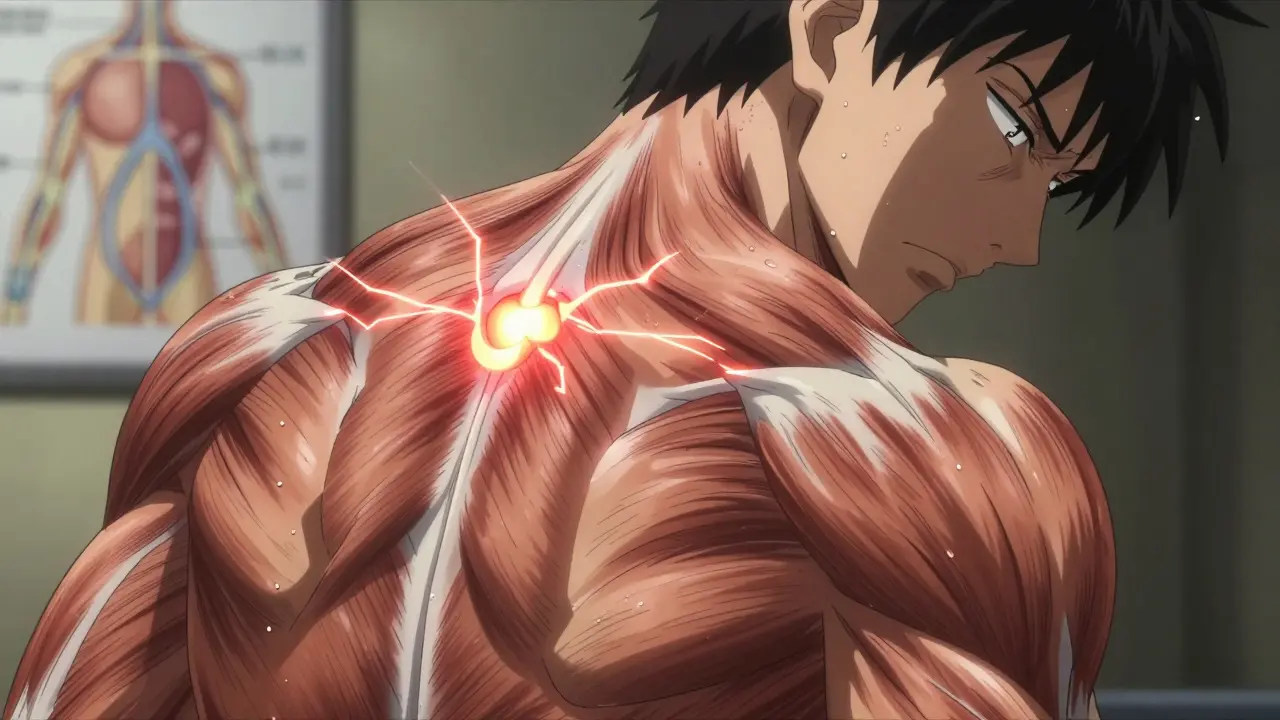
Chronic muscle pain that won’t go away-even after rest, ice, or painkillers-might not be a pulled muscle or a pinched nerve. It could be myofascial pain syndrome (MPS), a condition rooted in tight, irritated spots inside your muscles called trigger points. These aren’t just sore spots. They’re hyperactive knots that send pain racing to other parts of your body, often mimicking arthritis, headaches, or even heart problems. If you’ve been told everything’s "normal" on an X-ray but still hurt, MPS could be the hidden culprit.
What Are Trigger Points, Really?
Trigger points aren’t just tenderness. They’re physical knots inside taut bands of muscle, usually about the size of a pea or a small grape. When you press on them, you don’t just feel local pain-you feel it shoot into your shoulder, down your arm, or into your jaw. That’s referred pain, and it’s the hallmark of MPS.
These knots form because muscle fibers get stuck in constant contraction. Think of it like a flashlight battery that’s been left on too long-it drains, overheats, and stops working right. In your muscle, this means the muscle fibers stay tight, cutting off blood flow. That lack of oxygen creates a chemical soup: too much acetylcholine, too little pH, and a flood of pain-signaling chemicals. The result? A self-sustaining cycle of pain, tightness, and more pain.
There are two types: active and latent. Active trigger points hurt on their own. You don’t even need to touch them-just moving your neck or typing might trigger a sharp, burning ache. Latent ones? They only hurt when you press on them. But they’re still trouble. Left alone, they can turn active during stress, injury, or poor posture.
Where Do Trigger Points Hide?
Trigger points show up in predictable places, especially in muscles that work hard or get strained daily. The most common? The upper trapezius-the muscle that runs from your neck to your shoulder. If you’re hunched over a computer, you’ve got a 65% chance of developing one here. The levator scapulae, which lifts your shoulder blades, is next. That’s often the source of that deep, nagging pain between your shoulder and neck.
Then there’s the temporalis, the muscle in your temple. Trigger points here can cause what feels like a migraine-throbbing pain around the eye, ear, or jaw. People often get dental work done thinking it’s a tooth problem, when it’s actually a trigger point in their temple muscle.
Other frequent spots: the rhomboids (between shoulder blades), the gluteus medius (hip pain mistaken for sciatica), and the quadratus lumborum (lower back pain that feels like a disc issue). If your pain doesn’t follow a nerve path but still radiates oddly, think trigger point.
How Is It Different From Fibromyalgia?
People often confuse myofascial pain syndrome with fibromyalgia. They both involve chronic pain, but they’re not the same. Fibromyalgia is widespread. It hits symmetrically-both sides of your body, all at once. You’ll feel tenderness in 18 specific spots, but pressing on them doesn’t send pain shooting down your leg or into your head. It just hurts right where you touch.
Trigger points? They’re localized in taut bands of muscle, not at tendon attachments. And they refer pain. That’s the big difference. One trigger point in your trapezius can cause pain in your hand. One in your jaw muscle can make your ear ring. Fibromyalgia doesn’t do that. If your pain moves around in a pattern, it’s likely MPS.
What Causes Trigger Points to Form?
It’s not just "being stressed." Trigger points form from specific physical triggers:
- Posture: Sitting with your head jutted forward for hours? That’s a 3-5 times higher risk for trigger points in your neck and shoulders.
- Injury: Whiplash from a car accident? Up to 70% of people develop MPS within months.
- Imbalances: A leg length difference of just 1 cm increases your risk by 40%.
- Nutrition: Low vitamin D (under 20 ng/mL) is linked to 60% higher MPS rates. Hypothyroidism is found in 15-25% of chronic cases.
- Repetitive strain: Typing, lifting, or even holding a phone between your ear and shoulder can do it.
And here’s the kicker: trigger points don’t always hurt right away. They can lie dormant for months-until you sleep funny, lift something heavy, or get sick. Then-boom-you’re in pain again.
How Do Doctors Diagnose It?
There’s no blood test. No MRI that picks it up. Diagnosis is all about touch. A trained clinician will feel for taut bands in your muscle. Then they press on the suspected trigger point. If you feel pain exactly where they press-and it radiates to the spot you’ve been complaining about-that’s a sign.
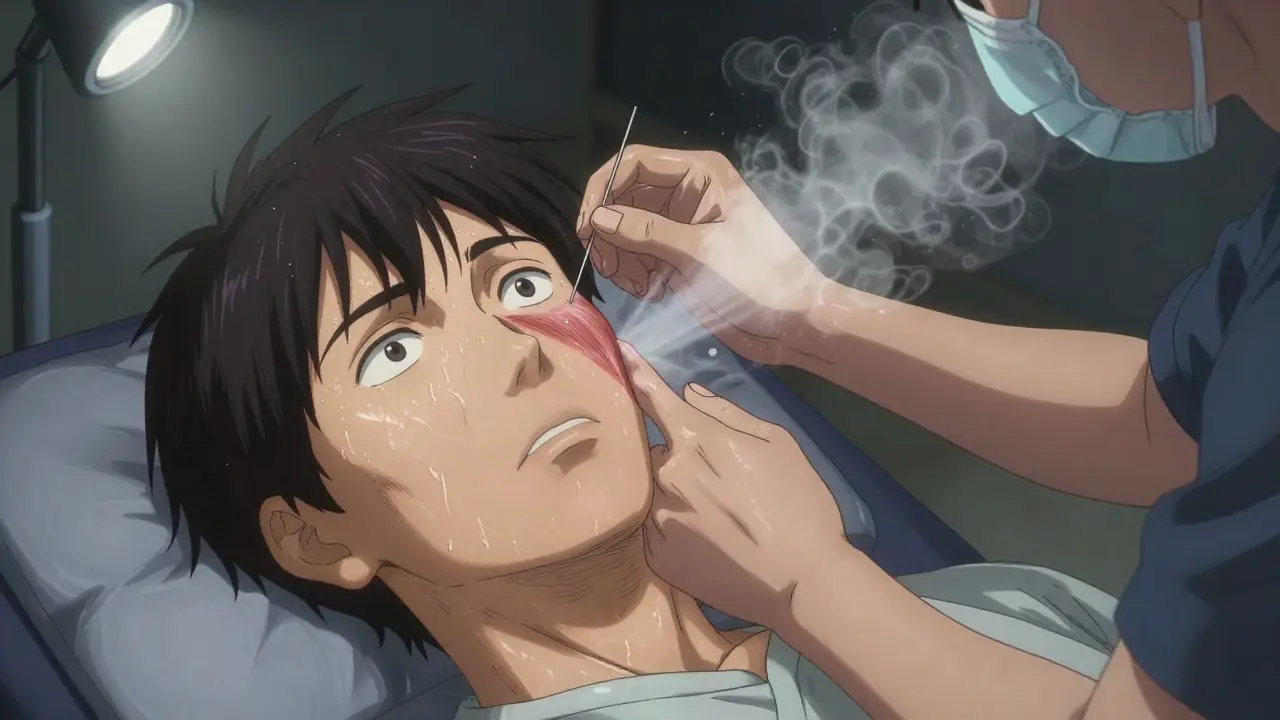
The gold standard is the local twitch response. When the trigger point is pressed or needled, the muscle fibers contract involuntarily-like a little jump under the skin. That happens in 70-85% of active trigger points. It’s not just pain. It’s a physical reaction that confirms the knot is real.
But here’s the problem: not all practitioners are trained. Studies show inter-rater reliability varies wildly-from poor to excellent-depending on experience. That’s why some people get no relief after treatment. It’s not the technique. It’s the person doing it.
Trigger Point Release Techniques That Work
There’s no magic bullet, but several methods have solid evidence behind them.
Ischemic Compression
This is the simplest. You press directly on the trigger point with your thumb, knuckle, or a tennis ball. Hold for 30 to 90 seconds until the pain eases by about 50%. It’s uncomfortable, but it should get easier as you hold. Do this 2-3 times a day. Studies show 60-75% of people get short-term relief.
Try this: Sit against a wall. Place a tennis ball between your upper back and the wall. Find the tender spot. Lean into it. Breathe. Don’t hold your breath. Hold until the pain dulls. Repeat on both sides.
Dry Needling
This is where a thin needle is inserted into the trigger point-no medicine, just the needle. It’s not acupuncture. It’s meant to hit the knot and cause a twitch response. When it works, pain drops 65-80% and lasts 4-12 weeks. It’s especially effective for deep muscles like the piriformis or psoas that you can’t reach with your hands.
Research shows it’s as effective as trigger point injections with lidocaine-but without the needle stick of a shot. The downside? It’s not always covered by insurance. And if done by someone inexperienced, it can make things worse.
Trigger Point Injections
These use a local anesthetic like lidocaine. They work fast-70-85% of people feel relief within minutes. But the effect fades in 2-8 weeks. A Cochrane Review found no big difference between injections and dry needling after four weeks. So if you’re looking for long-term relief, injections alone won’t cut it. They’re best as a jumpstart, paired with movement and stretching.
Spray and Stretch
This one’s old-school but still useful. A cold spray (like ethyl chloride) is sprayed over the area where the pain radiates. Then, the muscle is gently stretched. The cold numbs the skin and tricks the nervous system, letting you stretch deeper. Works best for neck and shoulder trigger points. About 50-65% effective.
Instrument-Assisted Soft Tissue Mobilization (IASTM)
Tools like Graston or ASTYM are scraped over the muscle to break up adhesions. It’s not massage. It’s targeted friction. It’s effective for chronic cases where muscles have thickened or scarred. Studies show 55-70% improvement.
Low-Level Laser Therapy (LLLT)
This uses specific wavelengths of light (808-905 nm) to reduce inflammation and improve blood flow. It’s non-invasive. Sessions take 5-10 minutes. Pain reduction is slower-40-60% over several weeks-but it’s great for people who can’t tolerate pressure or needles.
Why Do People Keep Relapsing?
Here’s the hard truth: trigger points come back if you don’t fix the root cause. You can release a knot in your trapezius, but if you keep slouching at your desk, it’ll return in weeks.
A study of 1,245 patients found that those who combined manual therapy, dry needling, and daily stretching saw a 65% drop in pain at 12 weeks. Those who didn’t do the home routine? Only 35% improvement. And 40-60% of all patients report pain returning within six months without maintenance.
Reddit users say it best: “After three dry needling sessions, my shoulder pain dropped from 8/10 to 3/10. But it crept back to 6/10 after eight weeks.” Or: “Ischemic compression with a tennis ball helped my TMJ more than my $400 mouthguard.”
Self-care isn’t optional. It’s the treatment.

What You Can Do at Home
You don’t need a clinic to manage this. Here’s a simple daily protocol:
- Heat first: Apply a warm pack (40-45°C) for 15 minutes before stretching. Heat loosens the muscle.
- Ischemic compression: Use a tennis ball, lacrosse ball, or foam roller. Target the knot. Hold until pain drops by half. Repeat 2-3 times per area.
- Stretch gently: Don’t bounce. Hold each stretch 30 seconds. Repeat 3 times. Focus on the muscle group where the trigger point lives.
- Posture check: Every hour, reset your shoulders. Roll them back. Tuck your chin slightly. Set a phone reminder if you need to.
- Check your vitamin D: If you’re always tired and sore, get tested. Under 30 ng/mL? Supplementation may help.
Compliance is low-only 45-60% of people stick with it past six weeks. But those who do? They’re the ones who stay pain-free.
When to See a Professional
Try self-care for 2-4 weeks. If there’s no improvement-or if pain worsens-see someone trained. Look for:
- Physical therapists with trigger point certification
- Chiropractors trained in myofascial release
- Doctors who use dry needling (not just acupuncture)
Avoid anyone who can’t explain what a trigger point is, or who treats you with massage alone. MPS needs targeted pressure, not general relaxation.
And if you’ve had imaging (X-ray, MRI) that showed "nothing wrong" but you’re still in pain? That’s classic MPS. Don’t give up. Just find the right practitioner.
The Bigger Picture
Myofascial pain syndrome is one of the most common causes of chronic pain-but also one of the most overlooked. It accounts for 30% of all musculoskeletal visits to primary care. Yet, up to 57% of cases are misdiagnosed early on.
As opioid prescriptions drop, non-drug pain solutions like trigger point therapy are growing fast. The American Medical Association reports a 200% increase in referrals for manual therapies between 2015 and 2022.
Trigger points aren’t pseudoscience. They’re real. The evidence is mixed, yes-but so is the evidence for many chronic pain conditions. What matters is this: if you’ve got pain that moves, that comes from a tight band in your muscle, and that responds to pressure-then trigger point therapy works for you.
You don’t need to live with it. You just need to know where to look-and how to press.
beth cordell
January 13, 2026 AT 07:17Lauren Warner
January 13, 2026 AT 16:38Craig Wright
January 14, 2026 AT 13:48Lelia Battle
January 15, 2026 AT 21:28Ben Kono
January 17, 2026 AT 13:42Cassie Widders
January 18, 2026 AT 22:07Konika Choudhury
January 19, 2026 AT 04:05Jose Mecanico
January 21, 2026 AT 00:18Alex Fortwengler
January 22, 2026 AT 05:41jordan shiyangeni
January 24, 2026 AT 01:16George Bridges
January 25, 2026 AT 09:09Faith Wright
January 27, 2026 AT 02:16Audu ikhlas
January 28, 2026 AT 19:55