
NMS Symptom & Risk Assessment Tool
Symptom Check
Check all symptoms present in the past 24-48 hours:
Risk Factors
Check factors that apply to the individual:
IMPORTANT: If you or someone you know is experiencing severe symptoms like high fever, muscle rigidity, or confusion, call 911 or go to the emergency room immediately. NMS is a medical emergency that requires immediate treatment.
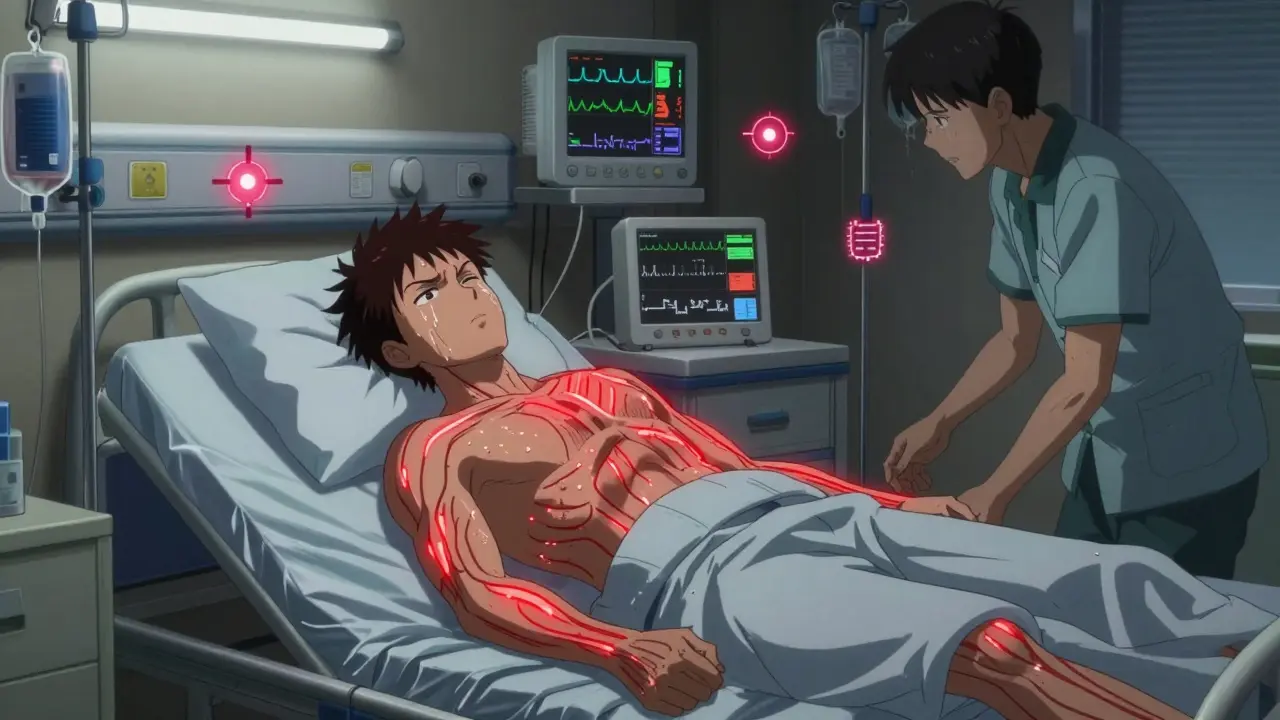
Neuroleptic Malignant Syndrome (NMS) isn’t something most people have heard of - until it happens. It’s rare, but when it strikes, it can turn a routine medication dose into a life-or-death emergency. Imagine waking up feeling like your body has turned to concrete. Your temperature spikes past 104°F. You can’t speak, move, or even blink properly. Your heart races, your blood pressure swings wildly, and your mind slips into confusion or silence. This isn’t a nightmare. It’s NMS - a severe, sometimes fatal reaction to antipsychotic drugs and other dopamine-blocking medications.
What Exactly Is Neuroleptic Malignant Syndrome?
NMS is a dangerous reaction triggered by drugs that block dopamine in the brain. Dopamine isn’t just about pleasure or motivation - it’s critical for movement, body temperature control, and heart rate. When antipsychotics like haloperidol, risperidone, or even anti-nausea meds like metoclopramide block dopamine receptors, especially in the hypothalamus and basal ganglia, the body loses its ability to regulate itself. The result? A cascade of physical breakdowns.
The classic signs are called the tetrad: muscle rigidity, high fever, altered mental status, and autonomic instability. Rigidity isn’t just stiffness - it’s lead pipe rigidity, where your limbs feel like they’re locked in place no matter how hard someone tries to move them. Fever isn’t a mild 100°F - it’s often above 102°F and can climb to 106°F. Mental status changes range from agitation and paranoia to complete mutism or coma. Autonomic instability means your body’s automatic systems go haywire: rapid heartbeat, sweating, unstable blood pressure, and fast breathing.
It’s not just antipsychotics. About 15% of NMS cases come from drugs like promethazine or metoclopramide - medications people often assume are harmless. Even stopping Parkinson’s meds like levodopa too quickly can trigger it. The timeline is unpredictable. Most cases show up within 1 to 2 weeks of starting or increasing a dose, but some hit within 48 hours. Others don’t appear until months later, even on a stable dose.
Why Is NMS So Dangerous?
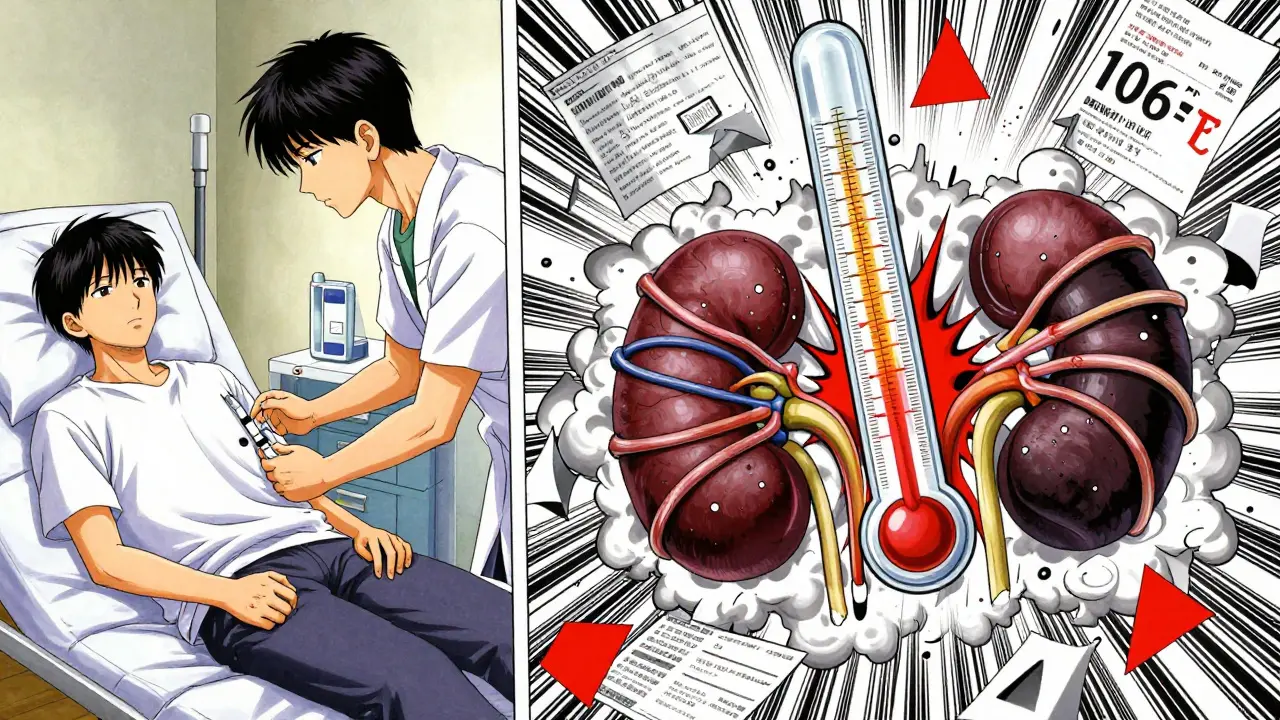
Left untreated, NMS kills 10% to 20% of people. Even with treatment, 5% still die. The real danger isn’t just the fever or rigidity - it’s what happens inside your muscles and kidneys.
Severe muscle rigidity causes muscles to break down. This is called rhabdomyolysis. When muscle cells die, they spill a protein called myoglobin into the bloodstream. Myoglobin clogs the kidneys, leading to acute kidney injury. About 30% of severe NMS cases end up needing dialysis. Creatine kinase (CK) levels - a marker of muscle damage - can skyrocket from a normal 60 IU/L to over 100,000 IU/L. That’s like your muscles turning to pulp.
Other complications include metabolic acidosis (your blood becomes too acidic), high potassium levels that can stop your heart, liver damage, and low iron. These aren’t side effects - they’re cascading organ failures triggered by one drug.
And here’s the kicker: NMS is often mistaken for something else. Emergency rooms see it as a psychotic episode, a stroke, a brain infection, or heatstroke. A 2021 study found that only 60% of ER doctors correctly identified NMS. That delay - even 24 hours - can mean the difference between recovery and death.
How Is NMS Different From Serotonin Syndrome or Malignant Hyperthermia?
People often confuse NMS with serotonin syndrome or malignant hyperthermia. They all cause fever and muscle issues, but the differences matter.
Serotonin syndrome comes from too much serotonin - usually from mixing antidepressants. It hits fast - within hours. You get clonus (involuntary muscle twitches), hyperreflexia (overactive reflexes), diarrhea, and tremors. NMS? Slower onset, no clonus, more mutism and rigid muscles.
Malignant hyperthermia happens during anesthesia. It’s lightning-fast - minutes after exposure to certain gases. You get jaw spasms (masseter spasm), rapid breathing, and dark urine. It’s genetic and tied to specific anesthetics. NMS? No genetic link. Triggered by antipsychotics. Slower. More common in psychiatric patients.
Even though they’re different, they’re treated similarly: stop the trigger, cool the body, and use dantrolene. But misdiagnosing NMS as serotonin syndrome means giving the wrong drugs - like cyproheptadine - which won’t help and might hurt.
Who’s at Risk?
It’s not random. Certain factors raise your risk dramatically:
- Using first-generation antipsychotics (like haloperidol or fluphenazine)
- Rapidly increasing the dose - especially jumping haloperidol by more than 5 mg per day
- Getting shots of antipsychotics (injections hit the bloodstream faster)
- Combining antipsychotics with lithium or antidepressants
- Being male and under 40
- Having bipolar disorder (higher risk than schizophrenia)
- Dehydration or heat exposure
Interestingly, about 60% of cases happen when someone first starts the medication. Another 30% occur when the dose is increased. Only 10% happen during stable, long-term use. That’s why the first few weeks are the most dangerous.
What Happens When NMS Is Diagnosed?
Time is everything. The moment NMS is suspected, the drug must be stopped immediately. No exceptions. Then, the patient is rushed to the ICU.
Here’s what happens next:
- Stop all dopamine blockers - including anti-nausea meds, antipsychotics, even certain antibiotics like metronidazole if they’re suspected.
- Cool the body - ice packs, cooling blankets, cold IV fluids. If temperature is above 102°F, aggressive cooling starts right away.
- Hydrate aggressively - 1 to 2 liters of IV fluids right away, then 100-150 mL/hour to protect the kidneys. Urine output must stay above 30 mL/hour.
- Use dantrolene - a muscle relaxant that helps stop muscle breakdown. Dose: 1-2.5 mg/kg IV, repeated up to 10 mg/kg if needed.
- Use bromocriptine or amantadine - these drugs mimic dopamine to restore balance in the brain. Bromocriptine is given orally every 8 hours.
- Monitor constantly - CK levels every 6-12 hours, kidney function, electrolytes, blood gases. CK peaks around 72-96 hours after onset.
Recovery takes time. Most people start improving in 7-10 days if treated early. But full muscle recovery can take weeks or months. One patient on a support forum said it took 8 weeks before he could walk without help.

What Happens After Recovery?
Survivors often face a terrifying question: Can I ever take antipsychotics again?
A 2022 survey found that 65% of NMS survivors refused to restart any antipsychotic - even if their psychosis returned. That’s a huge problem. Many people need these drugs to stay stable.
Doctors now use a cautious approach. If antipsychotics are absolutely necessary, they wait at least 2 weeks after full recovery. Then, they start with a low-dose second-generation antipsychotic - like quetiapine or clozapine - which carry a much lower risk (0.01-0.02% vs. 0.5-2% for older drugs). They monitor closely for the first 10 days. Some centers now use AI tools to flag early signs of NMS in electronic records, catching problems before they escalate.
Research is moving fast. A phase II trial at the Cleveland Clinic is testing intranasal apomorphine - a dopamine agonist - to reverse NMS symptoms in under 4 hours. Early results show promise. The FDA now requires black box warnings on all antipsychotics, reminding doctors that NMS can happen even with "therapeutic" doses and no known risk factors.
What Should You Do If You Suspect NMS?
If you or someone you know is on an antipsychotic and suddenly develops:
- Severe muscle stiffness that doesn’t go away
- Fever above 100.4°F
- Confusion, agitation, or inability to speak
- Rapid heartbeat, sweating, or unstable blood pressure
Call 911 or go to the ER immediately. Tell the staff: "I’m on an antipsychotic and I think I might have NMS." Don’t wait. Don’t assume it’s "just a bad reaction" or "worsening psychosis."
Bring a list of all medications - including over-the-counter ones. Metoclopramide for nausea? Promethazine for vomiting? Those can trigger it too.
And if you’re a caregiver: learn the signs. NMS doesn’t always look like a mental health crisis. Sometimes, it looks like the body is shutting down.
Final Thoughts
NMS is rare, but it’s real. And it’s deadly if ignored. Thanks to better drugs and faster recognition, survival rates have jumped from 76% in the 1980s to 95% today. But that 5% who don’t make it? They’re often the ones who waited too long.
Knowledge saves lives. If you’re on antipsychotics, know the red flags. If you’re a doctor or nurse, don’t dismiss rigidity and fever as "just the illness." If you’re a family member, speak up. NMS doesn’t care if you’re young, healthy, or on a "safe" dose. It strikes silently - and it strikes fast.
The good news? With awareness, it’s preventable. With speed, it’s treatable. And with the right care, most people go on to live full lives - even if they never take another antipsychotic again.
David Chase
December 30, 2025 AT 21:11Tamar Dunlop
January 1, 2026 AT 11:41Emma Duquemin
January 1, 2026 AT 23:39Duncan Careless
January 2, 2026 AT 16:35Russell Thomas
January 3, 2026 AT 04:31Joe Kwon
January 3, 2026 AT 19:28Nicole K.
January 5, 2026 AT 12:14Fabian Riewe
January 7, 2026 AT 09:51Henriette Barrows
January 7, 2026 AT 20:47Alex Ronald
January 9, 2026 AT 17:47Teresa Rodriguez leon
January 9, 2026 AT 20:48Samar Khan
January 11, 2026 AT 01:03Amy Cannon
January 11, 2026 AT 02:24