
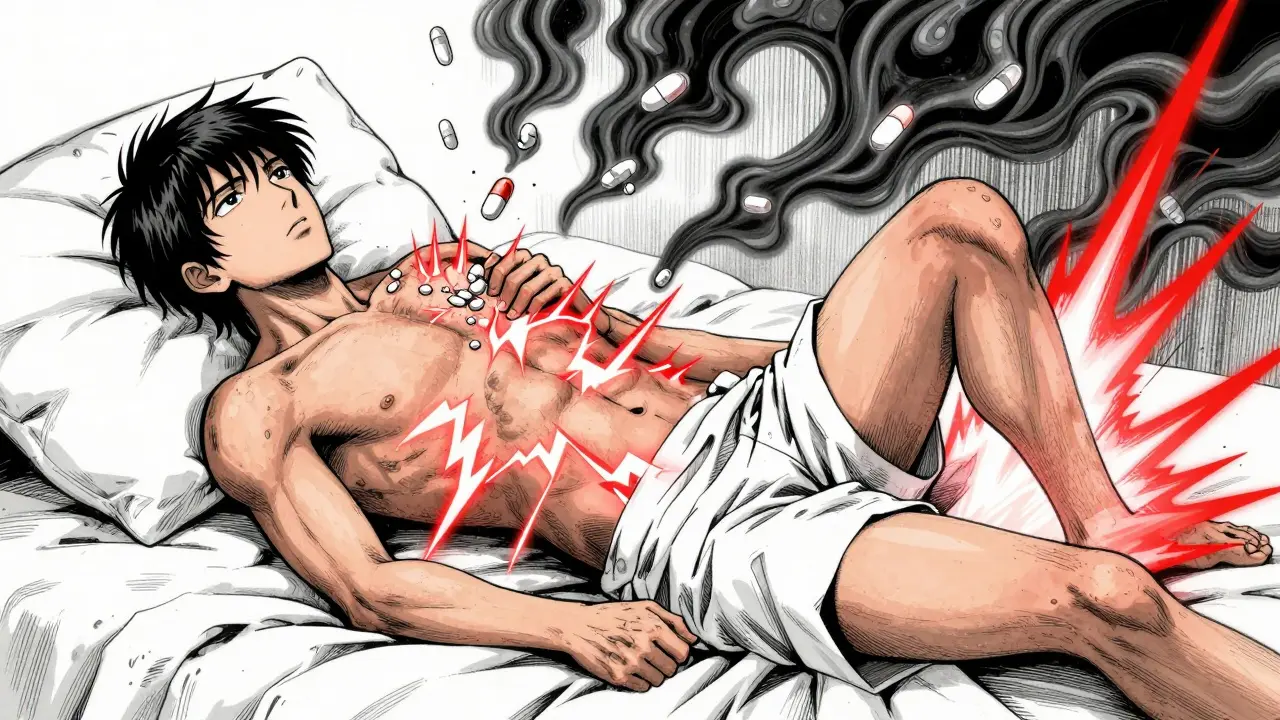
It sounds backwards: you’re taking opioids to relieve pain, but your pain gets worse. Not a little worse - dramatically worse. You increase the dose, hoping for relief, and instead, the pain spreads. A simple touch hurts. The area around your original injury becomes sensitive to clothing, a breeze, even a bedsheet. This isn’t a mistake. It’s not addiction. It’s opioid-induced hyperalgesia - or OIH.
What Exactly Is Opioid-Induced Hyperalgesia?
OIH is a paradox. Instead of calming your nervous system, long-term opioid use can make it hypersensitive. Your brain and spinal cord start overreacting to pain signals. Even mild stimuli - like light pressure or a cool room - can trigger sharp pain. This isn’t tolerance, where you need more drug to get the same effect. This is your body actually becoming more sensitive to pain because of the opioid itself.
First noticed in animal studies back in 1971, OIH is now a well-documented problem in humans. About 2% to 15% of people on long-term opioids develop it. In some clinics, up to 30% of cases once labeled as "tolerance" were actually OIH. The key clue? Pain gets worse when you increase the opioid dose. That’s the opposite of what you’d expect.
How Do You Know If You Have It?
Recognizing OIH is tricky because it looks a lot like other problems. But here are the red flags:
- Your pain spreads beyond its original location - it becomes diffuse, unpredictable.
- You develop allodynia: pain from things that shouldn’t hurt, like brushing your skin or wearing socks.
- Your pain gets worse even though you’re taking more opioids.
- No new injury, infection, or disease progression explains the worsening pain.
- You’ve been on opioids for more than 2 to 8 weeks - OIH usually takes time to develop.
It’s not diagnosed with a blood test or scan. Doctors rely on pattern recognition. If your pain worsens with dose increases and no other cause shows up, OIH is likely. A tool called the Opioid-Induced Hyperalgesia Questionnaire (OIHQ) helps - it’s been shown to catch 85% of true cases.
Why Does This Happen?
It’s not just "your body gets used to it." OIH involves real changes in your nervous system. Here’s what’s going on inside:
- NMDA receptors in your spinal cord get overactivated. These are like volume knobs for pain signals. Opioids accidentally turn them up.
- Your body releases more dynorphin, a natural chemical that, ironically, increases pain.
- Some opioid metabolites - like morphine-3-glucuronide - are toxic to nerve cells and boost sensitivity.
- Your brain’s pain-control centers start sending facilitation signals instead of inhibition signals - basically, they’re shouting "more pain!"
- Genetics play a role too. People with certain COMT gene variants are more likely to develop OIH.
This is why some people can take opioids for years with no issue, while others develop OIH after just a few months. It’s biology, not weakness.
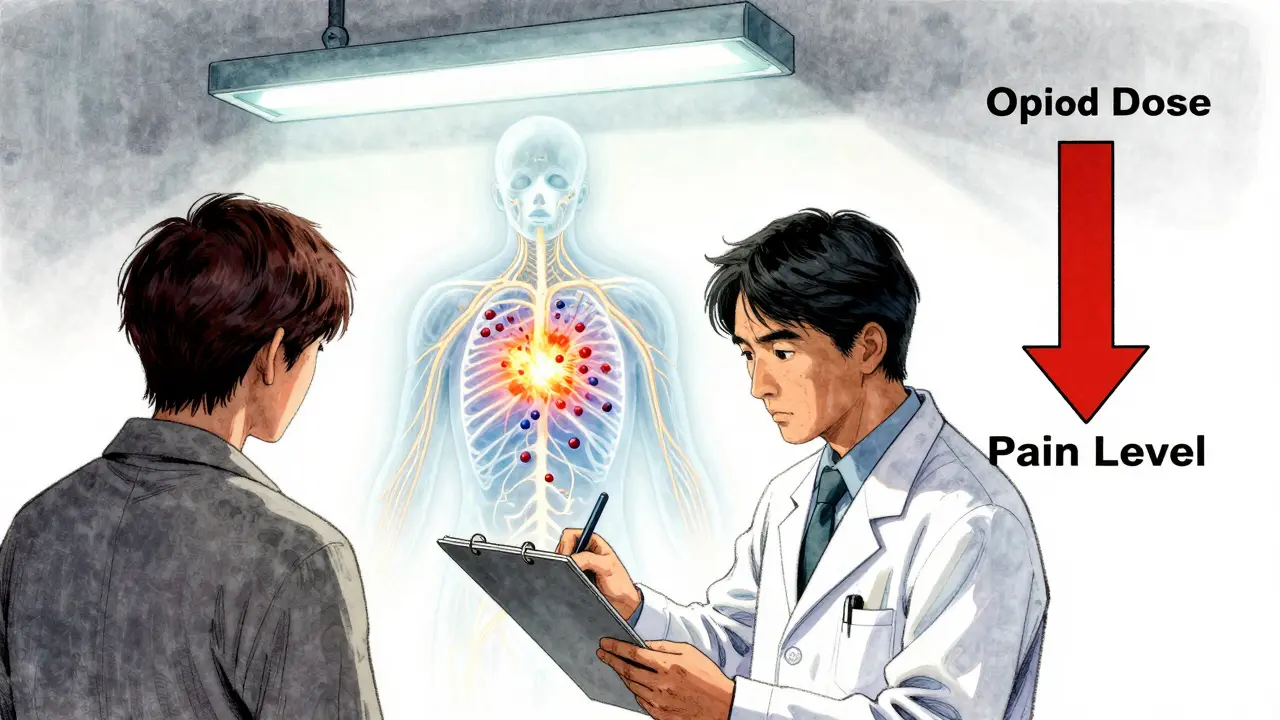
How Is It Treated?
The most important thing to understand: you don’t fix OIH by giving more opioids. That’s like trying to put out a fire with gasoline.
The first step is dose reduction. Lowering your opioid dose by 10% to 25% every few days often brings relief. It’s scary at first - you might feel worse before you feel better. But within 2 to 4 weeks, most patients see improvement. Full recovery can take up to 8 weeks.
Another option is switching opioids. Not all opioids are the same. Methadone and buprenorphine have extra properties - they block NMDA receptors - which can directly counteract OIH. Switching from morphine or hydromorphone to methadone often works well, especially in people with kidney problems who accumulate toxic metabolites.
Then there are targeted treatments:
- Ketamine: A low-dose IV infusion (0.1-0.5 mg/kg/hour) can reverse OIH by blocking NMDA receptors. It’s used in clinics and has strong evidence behind it.
- Clonidine: An alpha-2 agonist that calms overactive nerve signals. Usually taken as a pill (0.1-0.3 mg twice daily).
- Gabapentin or pregabalin: These help quiet down the nervous system’s noise. Doses range from 300-1800 mg daily, split into three doses.
Non-drug approaches matter too. Physical therapy helps retrain your nervous system. Cognitive behavioral therapy (CBT) teaches you how to respond differently to pain signals. Both reduce reliance on opioids and improve quality of life.
What Happens If You Ignore It?
Many patients get caught in a vicious cycle. Pain worsens → doctor increases dose → pain gets worse → dose gets increased again. This leads to higher opioid use, more side effects (constipation, drowsiness, respiratory depression), and greater risk of dependence. In some cases, patients are mislabeled as "drug-seeking" when they’re just experiencing a biological side effect.
And here’s the hard truth: OIH is still underdiagnosed. Even in 2026, many providers aren’t trained to spot it. The American Academy of Pain Medicine reports that only 65% of pain specialists routinely screen for it - up from 30% in 2010, but still too low.

Is OIH Real? Or Just Overhyped?
Some experts, like Dr. Perry Fine, argue that OIH is mostly seen in lab settings with experimental pain, not real chronic pain. But clinical experience tells a different story. Patients in palliative care, cancer centers, and chronic pain clinics consistently report dramatic improvement after opioid reduction or switching to methadone. The National Comprehensive Cancer Network (NCCN) now includes OIH in its official guidelines. The FDA even updated opioid labels in 2022 to warn about it.
And it’s not going away. Over 10 million Americans are still on long-term opioids. Even as prescribing drops, the people already on them need help. OIH isn’t a myth - it’s a treatable condition hiding in plain sight.
What’s Next?
Research is moving fast. The NIH is running a major study (NCT05217891) to find genetic markers that predict who’s at risk. By 2025, commercial genetic tests may identify people with COMT variants that make them prone to OIH. That could change how opioids are prescribed - testing before long-term use.
Pharmaceutical companies are also investing. Three new drugs targeting NMDA receptors or dynorphin pathways are in Phase II or III trials. The goal? Drugs that block OIH without reducing pain relief.
For now, the best tools are awareness and careful management. If you’re on opioids and your pain is getting worse despite higher doses - talk to your doctor. Ask if OIH could be the cause. You don’t have to keep suffering. There’s a way out.
Can opioid-induced hyperalgesia happen with low-dose opioids?
Yes. While OIH is more common with high doses - especially over 300 mg of morphine daily - it can occur at any dose. It’s more about duration and individual biology than the amount. People with kidney issues, genetic risk factors, or those on long-acting opioids are vulnerable even at lower doses.
How is OIH different from opioid tolerance?
Tolerance means you need more drug to get the same pain relief. OIH means your pain gets worse as you take more drug. With tolerance, increasing the dose helps. With OIH, increasing the dose hurts. They can happen together, but the key difference is the direction of pain change with dose changes.
Does stopping opioids completely cure OIH?
In many cases, yes. Once opioids are fully tapered, the nervous system gradually resets. Pain sensitivity returns to baseline over 4 to 8 weeks. But this must be done slowly and with support - abrupt withdrawal can cause severe symptoms. Combining tapering with non-opioid therapies like gabapentin or CBT improves success rates.
Is ketamine safe for treating OIH?
Yes, when used under medical supervision. Low-dose IV ketamine (0.1-0.5 mg/kg/hour) is not a recreational dose - it’s carefully controlled and monitored. It doesn’t cause hallucinations at these levels and has been used safely in pain clinics for over a decade. Studies show it reverses OIH in 70-80% of patients within days.
Why isn’t OIH talked about more by doctors?
Because it’s counterintuitive. Doctors are trained to increase opioids for worsening pain. OIH flips that logic. Many weren’t taught about it in medical school. Also, there’s no simple test - diagnosis requires pattern recognition. But awareness is rising. By 2024, 78% of pain fellowships include OIH training, and major guidelines now list it as a key consideration.
Agbogla Bischof
March 23, 2026 AT 15:56Just wanted to add that OIH isn't just a myth peddled by anti-opioid activists-I've seen it firsthand in my clinic. A patient on 120mg morphine daily for back pain started complaining his thighs hurt from socks. We dropped his dose by 20%, and within 10 days, he was walking without flinching. No new injury. No infection. Just OIH.
Also, the NMDA receptor mechanism is key. That's why ketamine works so well-it's not magic, it's neuropharmacology. And yes, even low-dose users can get it. Duration matters more than quantity.
Pat Fur
March 25, 2026 AT 03:04This is why I always say: pain is not a number. It's a conversation your body is having with itself. Opioids? They're like yelling into a microphone that's feedback-looping. You think you're turning down the noise, but you're just making the screech louder.
And honestly? The fact that we're still arguing about whether this is real in 2026 is heartbreaking.
Elaine Parra
March 26, 2026 AT 19:36Let's be real-this whole OIH thing is just a distraction from the fact that people are addicted and don't want to quit. You increase the dose and pain gets worse? That's called dependence. Not some fancy neurobiology.
And now we're giving people ketamine infusions? Next thing you know, we'll be handing out LSD for back pain. This is why America's healthcare system is broken.
Natasha Rodríguez Lara
March 27, 2026 AT 13:50Thank you for writing this. I've been living with chronic pain for 12 years, and I was told I was "just being dramatic" when my pain spiked after my last dose increase. I felt so alone.
Reading about dynorphin and COMT variants? That’s the first time I felt like someone actually understood my body wasn’t broken-it was responding.
Also, I switched from hydromorphone to methadone last month. My allodynia is 70% better. No hallucinations. No euphoria. Just… relief.
To anyone reading this: you’re not weak. You’re not addicted. You’re just biologically unlucky. And you deserve better care.
Caroline Bonner
March 29, 2026 AT 07:08Wow, this article is so thorough, I’m literally tearing up. I’ve been advocating for pain patients for over a decade, and this is the clearest, most compassionate breakdown of OIH I’ve ever seen.
And I just have to say-this whole idea that increasing opioids fixes pain? It’s like trying to fix a leaky roof by adding more rain.
Also, the genetic angle? COMT variants? That’s huge. We need universal screening before long-term prescribing. Why are we still treating pain like it’s a one-size-fits-all problem? We don’t prescribe antibiotics without checking for allergies-why do we do this with opioids?
And I’m so glad you mentioned CBT and PT. People think it’s "just in their head," but neuroplasticity is real. Your nervous system can rewire-especially when you stop flooding it with opioids.
Also, the FDA update in 2022? Long overdue. I hope this becomes mandatory training in med school next year. I’m sharing this with every patient I work with.
Katie Putbrese
March 29, 2026 AT 12:20So let me get this straight-you’re saying we should give people ketamine and lower their opioids because they’re in pain? That’s not treatment. That’s enabling. If you’re addicted, you need to quit. Not get more drugs.
And why are we even talking about genetics? That’s just giving people an excuse. No one gets to say "my genes made me do it." We all have free will.
This is why our country is falling apart. Weakness disguised as science.
Jacob Hessler
March 30, 2026 AT 00:39bro i had this happen to me. took oxys for 3 months after surgery. pain got worse. doc upped it. pain got worse. i was like wtf. finally found a doc who knew about oih. dropped dose. switched to buprenorphine. 3 weeks later i could sleep without screaming. life changer.
also why do docs not know this???
Amber Gray
March 30, 2026 AT 23:37OMG YES 😭 I thought I was crazy. My skin started hurting from wind. I cried because my dog licked my leg. I was on 400mg morphine. Then they switched me to methadone. Now I can wear a shirt. I’m not "addicted"-I was in a biological trap. Thank you for writing this.
Danielle Arnold
March 31, 2026 AT 08:40So let me summarize: you took opioids, got worse, now you want more drugs? Classic.
Korn Deno
April 1, 2026 AT 06:18The real tragedy isn’t OIH-it’s that we treat pain as a problem to be solved with chemistry, not a signal to be understood. We don’t ask why the alarm is going off. We just smash the alarm.
OIH isn’t a side effect. It’s a message. Your nervous system is screaming: "This isn’t helping. Stop."
And yet we keep doubling down because it’s easier than rethinking how we approach pain.
Maybe the real cure isn’t ketamine or methadone-it’s humility.
Anil Arekar
April 1, 2026 AT 17:17Thank you for this comprehensive and deeply humane overview. As a clinician in India, I encounter this phenomenon frequently, yet it is rarely acknowledged in our training curricula. The cultural stigma around opioid use makes diagnosis even more difficult.
However, I have observed that patients who undergo gradual tapering, combined with mindfulness-based stress reduction and physical rehabilitation, experience remarkable recovery-even without ketamine or methadone.
It is not merely a pharmacological issue. It is a systemic one. We must train providers, educate patients, and destigmatize the very act of reducing opioids-not as failure, but as wisdom.
Let us not mistake compassion for weakness.
Kevin Siewe
April 3, 2026 AT 05:15I’m a physical therapist who’s worked with chronic pain patients for 15 years. I’ve seen this over and over. The moment we stop pushing opioids and start teaching nervous system regulation-breathing, pacing, graded exposure-the pain starts to recede.
It’s not about eliminating pain. It’s about changing the relationship to it.
And honestly? The fact that we’re still debating whether this is real… that’s the real crisis.