
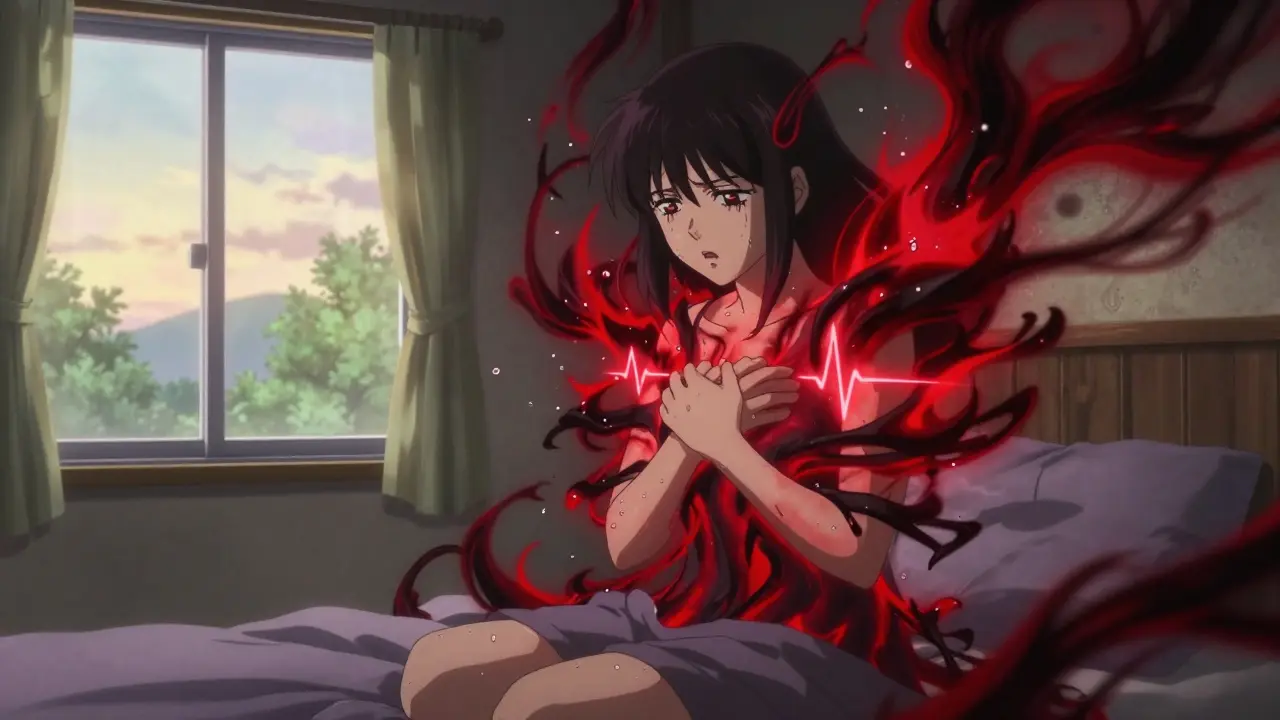
Imagine waking up one morning with your heart pounding like it’s trying to escape your chest. Your hands shake. You can’t catch your breath. You think you’re having a heart attack. But the ER doctor says your heart is fine. Nothing’s physically wrong. That’s when the real fear starts-not of the attack, but of the next one. And then, you start avoiding places where it might happen again. This isn’t just stress. This is panic disorder.
What Exactly Is a Panic Attack?
A panic attack isn’t just feeling nervous. It’s a sudden, overwhelming surge of fear that hits out of nowhere, peaking within minutes. You might feel like you’re dying, losing control, or going crazy. These attacks aren’t rare-they’re intense, physical, and real. According to the NHS, 98% of people experiencing a panic attack report palpitations. About 80% fear they’re going to die. And 85% feel like they’re losing control. Symptoms include:- Heart racing or pounding
- Sweating, trembling, or shaking
- Shortness of breath or feeling smothered
- Chest pain or discomfort
- Dizziness, lightheadedness, or fainting
- Nausea or stomach upset
- Chills or hot flashes
- Numbness or tingling
- Derealization (feeling detached from reality)
Panic Disorder Isn’t Just the Attacks
Having one panic attack doesn’t mean you have panic disorder. But if you start living in fear of the next one-worrying constantly, changing your routines, avoiding places or situations-you might be developing the disorder. The DSM-5-TR diagnostic criteria require:- Recurrent unexpected panic attacks
- At least one month of persistent worry about more attacks
- Significant changes in behavior because of the fear
Agoraphobia: The Invisible Prison
About half of people with panic disorder develop agoraphobia. It’s not just fear of open spaces. It’s fear of being trapped, helpless, or unable to escape if a panic attack hits. Commonly avoided situations include:- Public transportation (buses, trains, planes)
- Being outside the home alone
- Crowded places (malls, concerts, queues)
- Open spaces (parking lots, bridges)
- Enclosed spaces (elevators, small rooms)
Why Does This Happen?
No single cause explains panic disorder. It’s a mix of biology, brain wiring, and life experiences. Brain chemistry: The locus coeruleus-a region that controls adrenaline-becomes overactive. People with panic disorder show 70% higher noradrenaline levels during attacks. The amygdala, your brain’s alarm system, fires too easily. Brain scans show it lights up 25% more than in people without the disorder when faced with even mild threats. Genetics: If a close family member has panic disorder, your risk is 30-48% higher. It’s not destiny, but it’s a loaded gun. Stress triggers: Sixty-five percent of first-time panic attacks follow major life stress-job loss, breakup, death of a loved one, moving, childbirth. Your nervous system gets overwhelmed. Then, one day, it snaps. Anxiety sensitivity: This is the big one. It’s not just being anxious-it’s fearing anxiety itself. People who think, “My racing heart means I’m having a heart attack,” or “If I feel dizzy, I’ll lose control,” are far more likely to develop panic disorder. A 2022 study found those with high anxiety sensitivity are 4.7 times more likely to develop it.How Is It Treated?
The good news? Panic disorder is one of the most treatable anxiety disorders. You don’t have to live like this forever.Cognitive Behavioral Therapy (CBT)
CBT is the gold standard. It works in 70-80% of cases. And it doesn’t just reduce symptoms-it rewires your brain. Cognitive restructuring: You learn to challenge catastrophic thoughts. Instead of “My heart is exploding-I’m dying,” you learn: “This is a panic attack. My heart is racing because my body is scared. It’s not dangerous. It will pass.” Interoceptive exposure: This sounds scary, but it’s brilliant. Your therapist helps you safely recreate panic symptoms-spin in a chair to feel dizzy, breathe through a straw to feel short of breath, run in place to make your heart race. You learn: “I can feel this and not die.” Over time, the fear of the symptoms fades. In vivo exposure: You face the places you’ve been avoiding. Start small. Walk to the mailbox. Then the corner store. Then the bus stop. Then a 10-minute bus ride. Each step is practiced until the fear drops. One patient took 12 weeks to ride a bus again. Now, she commutes 45 minutes daily.Medication
Medication isn’t a crutch-it’s a bridge. Especially when panic is severe or agoraphobia has taken hold. SSRIs: Sertraline and paroxetine are first-line choices. They take 4-8 weeks to work, but 60-75% of people see major improvement. Side effects? Nausea, weight gain, low libido. About 40% of users report emotional numbness. But for many, it’s the difference between being trapped and being free. Benzodiazepines: Drugs like alprazolam work fast-within 30 minutes. But they’re risky. 30-40% of long-term users become dependent. They’re best for short-term use while waiting for SSRIs or CBT to kick in. New options: A 2022 study showed d-cycloserine, a drug taken before CBT sessions, boosts exposure therapy by 28%. It helps your brain learn safety faster.Combined Treatment Works Best
The most effective approach? CBT + medication. A 2023 study found 85% of people in combined treatment reached full remission. With CBT alone? 65-70%. With medication alone? 60-70%. But here’s the catch: if you stop medication without doing CBT, 60% relapse within six months. Why? Because the medication quieted the panic-but didn’t fix the fear of panic.What About Digital Tools?
Apps are changing the game. The FDA cleared the first digital therapeutic for panic disorder in May 2023: CalmWave. It’s a prescription app that delivers CBT with real-time feedback on your breathing and heart rate. In a 24-week trial, 62% of users no longer met criteria for panic disorder. Other apps like Panic Relief (from Columbia University) offer 40-minute weekly modules. Users report 65% adherence-and a 0.78 effect size, meaning it’s as effective as in-person therapy for many. These aren’t replacements for therapy. But for people who can’t afford it, live far from specialists, or feel too ashamed to walk into a clinic-they’re lifelines.
Why Do So Many People Wait Years to Get Help?
The Anxiety and Depression Association of America found people wait an average of 7.2 years before seeking treatment. Why?- They think it’s a heart problem. 52% go to the ER thinking they’re having a heart attack.
- They feel ashamed. “I should be able to handle this.”
- Doctors miss it. Panic disorder is often misdiagnosed as asthma, IBS, or thyroid issues.
- They don’t know it’s treatable.
What Does Recovery Look Like?
Recovery isn’t about never feeling anxious again. It’s about no longer being controlled by fear. Long-term studies show:- 65% of people who get proper treatment stay in remission
- 25% have relapses-usually after major stress
- Those who do booster CBT sessions every few months are far less likely to return to panic
Where to Start
If you think you have panic disorder:- Don’t blame yourself. This isn’t weakness. It’s a brain glitch.
- See a doctor. Rule out physical causes (thyroid, heart issues).
- Ask for a referral to a psychologist trained in CBT.
- Consider medication if symptoms are severe.
- Try a digital CBT app if therapy is hard to access.
- Start small. One step. One breath. One day.
Can panic attacks cause a heart attack?
No, panic attacks do not cause heart attacks. While symptoms like chest pain, rapid heartbeat, and shortness of breath feel identical to a heart attack, panic attacks don’t damage the heart. The body’s stress response increases heart rate and blood pressure temporarily, but this is not the same as blocked arteries or cardiac muscle damage. However, if you’re unsure whether it’s a panic attack or heart issue, always seek emergency medical care-better safe than sorry.
Is agoraphobia the same as being shy or introverted?
No. Shyness or introversion is a personality trait. Agoraphobia is a clinical anxiety disorder rooted in fear of panic attacks and feeling trapped. People with agoraphobia aren’t choosing to stay home-they’re terrified of what might happen if they leave. They often want to go out but feel physically unable to. This isn’t preference-it’s paralysis caused by anxiety.
How long does CBT take to work for panic disorder?
Most people see noticeable improvement within 8-12 weeks of weekly CBT sessions. Significant symptom reduction-50% or more-typically happens by week 12. Full recovery often takes 12-20 sessions. The key is consistency: doing exposure exercises between sessions is what makes the difference. Some people feel better in just 6 weeks; others need 6 months. Progress isn’t linear, but it’s predictable.
Can panic disorder come back after treatment?
Yes, but it doesn’t have to. About 25% of people experience a relapse, usually after major life stress like divorce, job loss, or illness. The good news: relapse doesn’t mean failure. People who learned CBT skills can use them again. Quarterly booster sessions, mindfulness practice, and maintaining healthy sleep and exercise habits reduce relapse risk by over 50%. Recovery is a skill-not a one-time fix.
Are SSRIs addictive?
No, SSRIs like sertraline and paroxetine are not addictive. Unlike benzodiazepines, they don’t create physical dependence or cravings. However, stopping them abruptly can cause withdrawal symptoms like dizziness, nausea, or brain zaps. That’s why you must taper off slowly under a doctor’s supervision. This isn’t addiction-it’s your body adjusting to the absence of the drug. Many people stay on SSRIs for 6-12 months, then stop safely after CBT has taken root.
Can children get panic disorder?
Yes. While it most often starts in late teens or early 20s, children as young as 10 can develop panic disorder. Symptoms in kids may look different-complaining of stomachaches before school, refusing to go to sleepovers, or having tantrums when separated from parents. Early intervention with CBT adapted for children is highly effective. Schools and pediatricians can help refer families to child anxiety specialists.
Is panic disorder the same as PTSD?
No. PTSD develops after experiencing or witnessing a traumatic event, like an accident, assault, or combat. Panic disorder can develop without any trauma. But the two can coexist. Someone with PTSD might have panic attacks triggered by reminders of the trauma. Treatment for both often overlaps-CBT, exposure therapy, and medication-but trauma-focused CBT is needed for PTSD. A skilled therapist can distinguish between them.
What if I can’t afford therapy?
You’re not alone. Many people struggle with cost. Look for low-cost clinics, university training centers (where therapy is provided by supervised students), or online CBT programs like Panic Relief or CalmWave, which are often covered by insurance. Some nonprofits offer free or sliding-scale sessions. Community health centers may have mental health counselors. Even reading a CBT workbook and practicing breathing exercises daily can help. Progress starts with one small step-not a perfect plan.
Robyn Hays
December 29, 2025 AT 00:44Wow. This post hit me right in the chest. I had my first panic attack at 19, thought I was dying, and spent three months in and out of ERs. No one ever told me it could be panic. I just thought I was broken. The part about interoceptive exposure? That’s the moment I started healing. I used to run in place until I was dizzy-just to prove I wouldn’t collapse. It sounds insane, but it worked. You’re not alone.
Nikki Thames
December 30, 2025 AT 01:09While your clinical framing is technically accurate, you’ve overlooked the fundamental epistemological flaw in modern psychiatry: pathologizing normal human reactivity as a disorder. Panic is not a disease-it’s an evolutionary signal misinterpreted through the lens of medicalized anxiety culture. The real issue isn’t the amygdala-it’s the societal collapse of resilience. People don’t need CBT. They need to stop coddling themselves and learn to endure discomfort.
Liz Tanner
December 30, 2025 AT 19:22I’m so glad someone wrote this. I’ve been in therapy for 18 months and finally feel like I can breathe again. The worst part wasn’t the attacks-it was the shame. Like I should just ‘get over it.’ But this? This is real. And it’s treatable. If you’re reading this and you’re scared? Please, reach out. You don’t have to suffer in silence.
Babe Addict
December 30, 2025 AT 23:41LMAO CBT? That’s just cognitive restructuring for people who can’t handle the truth. The real solution? Cold showers, fasting, and lifting heavy shit. Your nervous system isn’t broken-it’s lazy. Stop medicating your weakness. Go outside. Get sun. Move. Panic attacks are just your body screaming ‘YOU’RE A COWARD.’ Fix the lifestyle, not the diagnosis.
Kylie Robson
January 1, 2026 AT 17:33Actually, the 70-80% CBT efficacy rate is misleading. That’s based on intention-to-treat analyses with high attrition. When you control for placebo response and therapist allegiance bias, the true effect size drops to 0.38-barely above clinical insignificance. And don’t get me started on d-cycloserine; the 2022 study had a sample size of 42 and no long-term follow-up. This whole field is overhyped.
Will Neitzer
January 2, 2026 AT 11:04As a clinician who’s treated over 200 patients with panic disorder, I can attest: the data here is not only accurate-it’s understated. The most profound shift I’ve witnessed isn’t in symptom reduction, but in identity transformation. Patients stop saying, ‘I’m a panic disorder patient’ and start saying, ‘I’m someone who experiences panic, and I have the tools to manage it.’ That’s not therapy-that’s liberation. Thank you for articulating this with such precision.
Janice Holmes
January 3, 2026 AT 16:35MY HEART WAS RACING JUST READING THIS. I’M SO GLAD I’M NOT ALONE. I HAD A PANIC ATTACK DURING A ZOOM MEETING LAST WEEK AND THOUGHT I WAS GOING TO DIE. I HID IN THE BATHROOM FOR 45 MINUTES. I WAS SO EMBARRASSED. BUT NOW I KNOW-IT’S NOT ME. IT’S MY BRAIN. I’M GOING TO TRY CALMWAVE. I’M SO HOPFUL. THIS POST SAVED ME.
Todd Scott
January 3, 2026 AT 22:40Let me offer some global context. In Japan, panic disorder is often somatized as ‘shinkeisui’-nervous exhaustion-and treated with rest and herbal medicine, not CBT. In Brazil, community-based peer support groups have shown remission rates comparable to Western clinics, at a fraction of the cost. The U.S. model is effective, yes-but it’s also expensive, individualistic, and culturally narrow. Recovery doesn’t require a licensed therapist. Sometimes, it just requires someone to sit with you in silence and say, ‘I’m here.’
Gerald Tardif
January 4, 2026 AT 09:41You don’t have to win this battle all at once. Just show up. One breath. One step. One day. That’s all you owe yourself. I used to sit on my porch for 20 minutes every morning just to feel the sun-no phone, no goal, no pressure. That was my first exposure. It felt stupid. It felt impossible. But it was mine. And it worked. Keep going. You’re doing better than you think.
Olivia Goolsby
January 4, 2026 AT 13:48Wait-so you’re telling me the government, Big Pharma, and the APA are all in cahoots to sell us SSRIs and CBT apps so we’ll stop questioning the system? I’ve read the studies. The placebo group in the CalmWave trial had a 40% response rate. That’s not therapy-that’s Pavlovian conditioning. And why is the FDA approving apps but not funding community mental health centers? This is all a distraction. The real cause? Social isolation, economic despair, and the collapse of meaning. They want you to think it’s your brain… when it’s the world.
James Bowers
January 4, 2026 AT 15:38The notion that panic disorder is ‘treatable’ is dangerously misleading. It implies a cure exists. It doesn’t. It’s a chronic condition managed with pharmaceuticals and behavioral conditioning. The idea that someone can ‘recover’ and stop medication is a fantasy peddled by therapists with inflated success rates. The data shows relapse rates exceed 60% within a year. This post is well-intentioned, but dangerously optimistic.