

Imagine sitting at a crowded restaurant, trying to follow a conversation while the clatter of dishes, laughter, and background music drown out every word. For someone with hearing loss, this isn’t just frustrating-it’s exhausting. Hearing aids help, but they’re not enough. That’s where remote microphone systems come in. These aren’t sci-fi gadgets. They’re proven, FDA-cleared medical devices that can turn a noisy room into a clear conversation.
How Remote Microphone Systems Actually Work
At its core, a remote microphone system is simple: a small mic clips onto the person speaking, and it sends their voice directly to your hearing aids or cochlear implant. No shouting. No leaning in. Just clear sound, delivered right to your ears.
Traditional hearing aids pick up everything around you-the speaker, the clinking glasses, the TV in the corner. That’s fine in quiet places. But in noise? Your brain gets overwhelmed. Remote microphone systems bypass that. They capture speech just 6 to 8 inches from the speaker’s mouth, where the signal is strongest. Then, using a 2.4 GHz wireless connection (like Bluetooth but more reliable), they send that signal straight to your device. No interference. No delay. No competing sounds.
Early versions used FM radio frequencies in the 70s and 80s, mostly in classrooms. Today’s systems, like Phonak Roger and ReSound Multi Mic, use digital modulation. That means they hop between frequencies automatically to avoid interference from Wi-Fi, microwaves, or other wireless devices. The result? A signal that stays clear even in a busy hospital waiting room or a noisy office.
Why This Beats Hearing Aids Alone
Hearing aids have come a long way. Directional mics, noise reduction algorithms, AI-powered speech enhancement-they all help. But none of them fix the biggest problem: distance.
Sound loses half its strength every time you double the distance from the source. That’s called the 6 dB per doubling rule. If someone is talking to you from 3 feet away, their voice is already 6 dB quieter than if they were right next to you. At 6 feet? Another 6 dB down. By the time you’re across a dinner table, you’re missing nearly 75% of the speech signal.
Studies show remote microphone systems cut through that. In noise levels of 65-75 dBA (typical for restaurants and group meetings), users report up to a 61% improvement in speech understanding compared to hearing aids alone. One 2021 study found adults improved by 11-19.5 dB in speech-to-noise ratio. That’s not a small tweak-it’s like going from barely hearing someone to understanding them clearly without asking them to repeat themselves.
Children benefit even more. In classrooms, where background noise can hit 70 dBA, remote microphone systems help kids catch 80-90% of what’s said. That’s the difference between falling behind and keeping up.
Types of Systems and What Sets Them Apart
Not all remote microphone systems are the same. There are three main types, each with trade-offs:
- Directional adaptive systems (like Phonak Roger Select): These automatically detect who’s speaking and focus on them. If someone walks past you, the mic shifts. Best for group settings.
- Fixed omnidirectional systems (like Roger Pen): These pick up sound from all directions. Great for one-on-one chats or when you’re holding the mic yourself.
- Mini mics (like ReSound Mini Mic): Smaller and cheaper, but less powerful. They don’t adapt to noise, so they’re best in quieter environments.
Performance differences are real. In a 2021 study, directional adaptive systems outperformed fixed ones by 15-20 percentage points in noise levels above 65 dBA. Roger Select, with its adaptive tech, gave users 16% better speech recognition than the Roger Pen at -5 dB signal-to-noise ratios-the kind of challenge you face in a busy café.
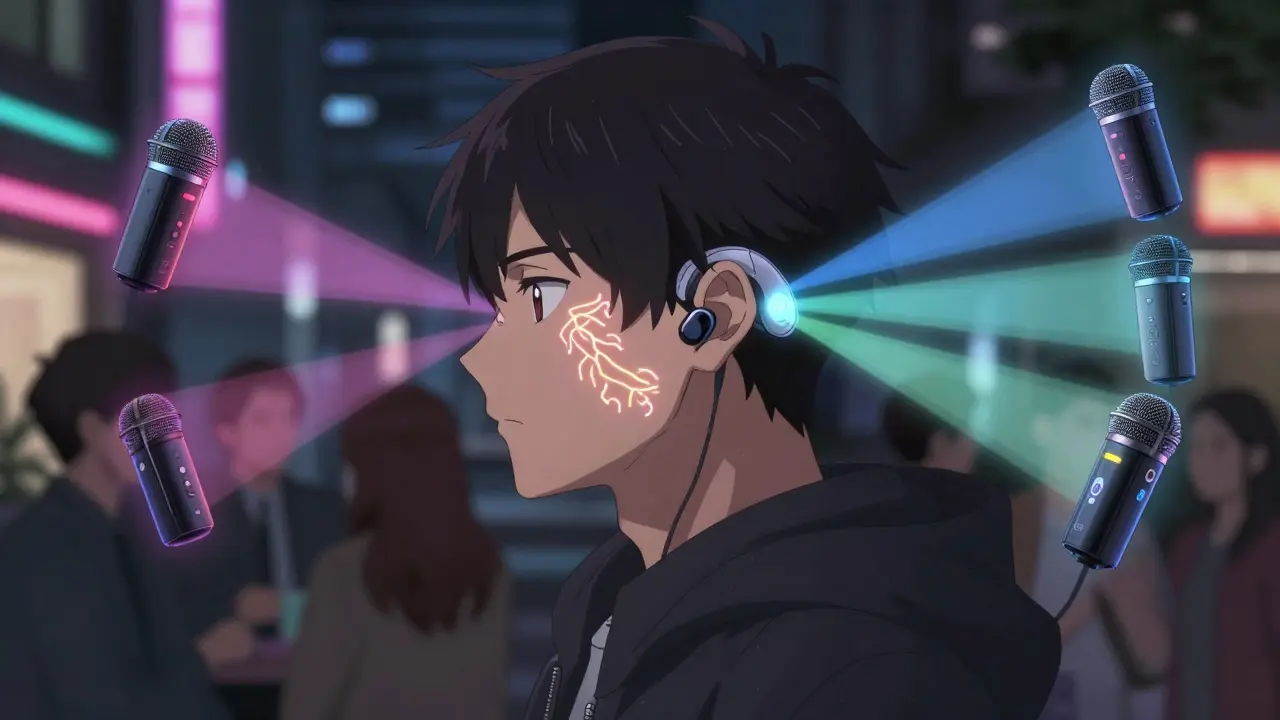
And then there’s the new generation. The Roger Focus II, released in 2023, can connect to multiple microphones at once. That means if you’re in a meeting with three people talking, you can clip a mic on each of them. Phonak’s own field study showed this setup improved speech recognition by 45% over hearing aids alone in multi-talker scenarios.

Real People, Real Results
Numbers tell part of the story. Real users tell the rest.
On Reddit, u/HearingHelp123 said: “I went from understanding 20% of family dinners to 85% with Roger Select.” A nurse on the same forum wrote: “My Roger Pen added five years to my working life.”
AuditoryOnline’s 2023 survey of 1,247 users found:
- 87% said listening in restaurants became significantly easier
- 78% could follow group conversations for the first time
- 89% would recommend the system to others
But it’s not perfect. Some users feel awkward asking people to wear a mic. One Trustpilot reviewer said: “People think I’m recording them.” That stigma is real-and it’s why many avoid using them in social settings.
Another big issue? Cost. Most systems range from $499 to $799. Medicare only covers 15% of the cost for qualifying users. Amazon reviews show 42% of complaints are about price. Insurance rarely helps, even though these are medical devices.
Getting Started: What You Need to Know
You can’t just buy one online and plug it in. These are medical devices that need professional fitting.
You’ll need:
- A hearing aid or cochlear implant with wireless connectivity (Bluetooth LE or proprietary 2.4 GHz)
- An audiologist who knows how to program the system
- At least 2-3 office visits for setup and training
The learning curve is mild. Most users get comfortable in 2-4 weeks. You’ll learn how to:
- Pair the mic with your hearing aids (like connecting Bluetooth headphones)
- Clip the mic correctly-6 to 8 inches from the speaker’s mouth
- Use lanyards to keep the mic in place (recommended by the Hearing Loss Association of America)
- Swap batteries or charge the device (most last 8-12 hours)
Support matters. Phonak offers 24/7 tech help. Smaller brands? You might be stuck waiting for business hours. That’s why user satisfaction scores are highest with brands that offer round-the-clock support.
What’s Next? The Future Is Integrated
The next big shift? Making the mic part of the hearing aid itself.
Phonak’s 2024 Roger X uses AI to separate speech from noise, boosting understanding by 9% in group settings. Starkey’s Evolv AI platform, launching late 2024, will automatically enhance speech without needing a separate mic. Oticon’s 2024 More hearing aid already has Roger tech built in-no extra receiver needed.
By 2027, the Hearing Industries Association predicts 60% of new hearing aids will include remote microphone tech as standard. That’ll cut costs by 25-30% as production scales up.
Right now, these systems are optional add-ons. Soon, they’ll be the norm.
Is It Worth It?
If you struggle in noisy places-restaurants, meetings, family gatherings-then yes. The data is clear. The user stories are real. This isn’t a luxury. For many, it’s the difference between isolation and connection.
It’s not magic. You still need to manage the mic. You still need to pay for it. But if you’ve ever sat through a dinner and felt like you were watching a silent movie, this is the upgrade you didn’t know you needed.
Ask your audiologist about remote microphone systems. Don’t assume your hearing aids are enough. They might be, but they’re not enough for noise. And noise is everywhere.
Do remote microphone systems work with all hearing aids?
No. They only work with hearing aids that support wireless connectivity via 2.4 GHz or Bluetooth Low Energy. Most major brands-Phonak, ReSound, Oticon, and Starkey-offer compatible models. If your hearing aids are older or from a smaller manufacturer, you may need an intermediary receiver or neckloop. Always check compatibility with your audiologist before purchasing.
Can I use a remote microphone system without a hearing aid?
No. These systems are designed as accessories for hearing aids or cochlear implants. They don’t amplify sound on their own. The receiver connects directly to your hearing device and sends the signal into your ear. Without a hearing aid, there’s no way to process or deliver the sound.
Are remote microphone systems covered by insurance?
Medicare covers only 15% of the cost for qualifying individuals. Most private insurers don’t cover them at all, treating them as “convenience devices” rather than medical necessities. Some state Medicaid programs and VA benefits may cover them for veterans or children. Always check with your provider and ask your audiologist to submit a letter of medical necessity-it can sometimes help.
How long do the batteries last?
Most remote microphones last 8-12 hours on a full charge, depending on usage and model. The Roger Select and Roger Focus II last up to 12 hours with continuous use. ReSound Multi Mic lasts about 10 hours. Battery life drops if you’re using multiple mics or streaming audio. Most systems come with charging cases, and spare batteries are available for purchase. Always carry a backup if you’re going out for the day.
Can I use these in a group setting with multiple speakers?
Yes, but only with newer systems. The Roger Focus II (2023) and Roger X (2024) can connect to up to four microphones at once. Each speaker clips on their own mic, and the system switches between them automatically. Older models like the Roger Pen can only handle one mic at a time. In group settings, you’ll need to pass the mic around unless you have the latest tech.
Do these systems help with tinnitus or other hearing issues?
No. Remote microphone systems are designed specifically to improve speech understanding in noise. They don’t treat tinnitus, hyperacusis, or auditory processing disorders. However, by reducing listening effort and stress, some users report secondary relief from tinnitus symptoms because their brains aren’t straining to hear.
Are there any downsides to using remote microphone systems?
Yes. The biggest issues are cost, social stigma, and reliance on the speaker wearing the mic. If the speaker forgets it, doesn’t wear it properly, or refuses to use it, the system won’t help. Some users feel awkward asking people to clip on a mic. Also, if multiple people are talking at once and you don’t have a multi-mic system, you’ll still miss parts of the conversation. Proper training and realistic expectations are key.
Kathy McDaniel
January 27, 2026 AT 03:56Worth every penny even if my insurance acted like I asked for a yacht.
Kirstin Santiago
January 28, 2026 AT 04:51Find an audiologist who actually uses these themselves. Makes a huge difference.
Anjula Jyala
January 28, 2026 AT 10:48Andrew Clausen
January 30, 2026 AT 02:28John O'Brien
January 30, 2026 AT 21:43Candice Hartley
February 1, 2026 AT 06:07astrid cook
February 3, 2026 AT 03:42Paul Taylor
February 3, 2026 AT 20:03Desaundrea Morton-Pusey
February 4, 2026 AT 03:54Murphy Game
February 4, 2026 AT 10:56Kegan Powell
February 6, 2026 AT 03:49