
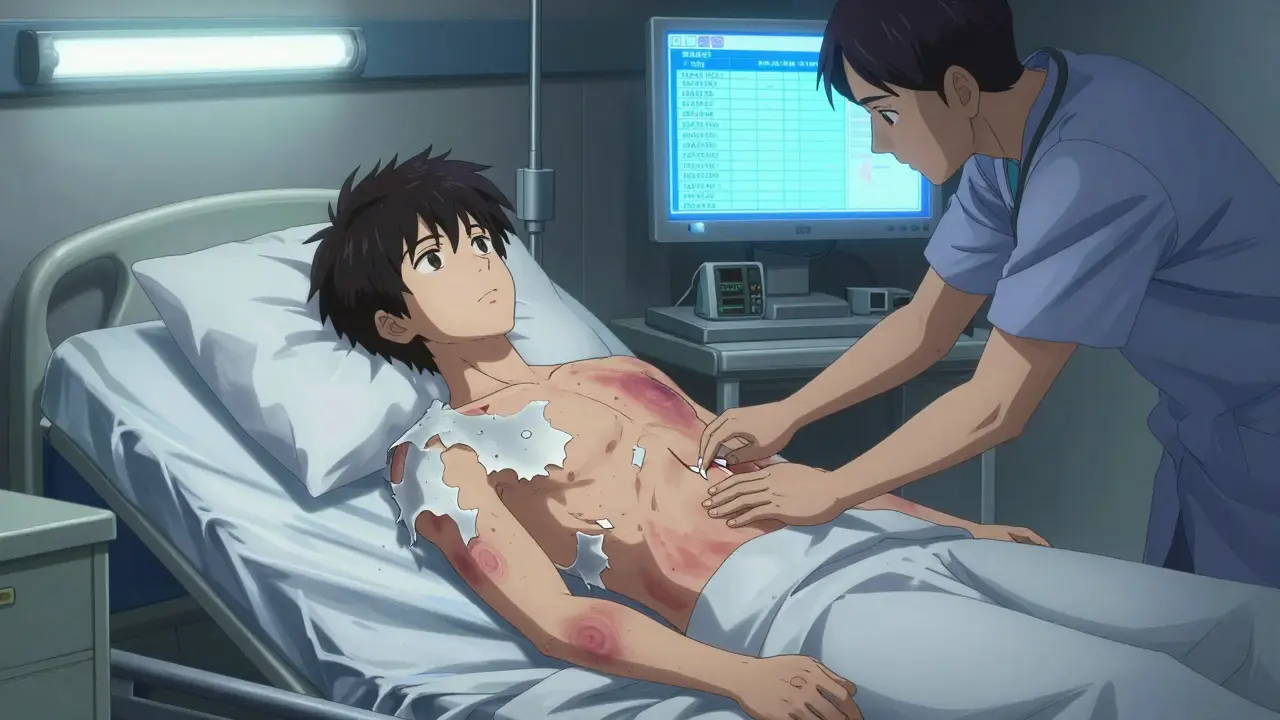
Stevens-Johnson Syndrome (SJS) and Toxic Epidermal Necrolysis (TEN) aren’t just rare skin conditions-they’re medical emergencies that can turn a routine medication into a life-threatening event. These reactions don’t happen overnight. They creep up with a fever, a sore throat, or a rash that starts small but spreads fast. By the time you see large sheets of skin peeling off, it’s already too late for simple fixes. The truth? Drug reactions are behind nearly every case.
How SJS and TEN Are Connected
SJS and TEN aren’t two separate diseases. They’re two ends of the same spectrum. Think of it like a sliding scale. At one end is SJS, where less than 10% of your skin detaches. At the other end is TEN, where more than 30% of your skin peels away like a burn. In between? A gray zone called SJS-TEN overlap, affecting 10% to 30% of the body. This isn’t just a label-it changes how doctors treat you.
Both conditions start with flu-like symptoms: fever over 38.9°C (102°F), headache, cough, sore throat, or burning eyes. These signs appear 1 to 3 weeks after taking a new medication. But if you’ve taken the drug before, symptoms can hit within 48 hours. That’s why re-exposure is so dangerous.
The real danger comes when flat red or purple spots turn into blisters. These aren’t ordinary pimples. They’re large, loose, and painful. The skin doesn’t just blister-it sloughs off in sheets. Doctors check for the Nikolsky sign: if you gently rub the skin and it peels away, that’s a red flag. And it’s not just the skin. At least two mucous membranes are always involved-usually the mouth, eyes, and genitals. You might not be able to swallow, blink, or urinate normally.
What Causes These Reactions?
Over 80% of cases are triggered by medications. The usual suspects? Antiepileptics like carbamazepine and lamotrigine, sulfonamide antibiotics like trimethoprim-sulfamethoxazole, and allopurinol (used for gout). Together, these three account for more than half of all cases.
But here’s the scary part: it’s not about dosage. Even a single pill can trigger this. And it’s not random. Your genes play a huge role. If you carry the HLA-B*15:02 gene variant, taking carbamazepine increases your risk of SJS/TEN by up to 1,000 times. This variant is common in people of Asian descent. Similarly, HLA-B*58:01 raises allopurinol risk by 80 to 580 times across all ethnic groups.
That’s why countries like Taiwan now require genetic testing before prescribing carbamazepine. Since 2007, they’ve cut SJS/TEN cases by 80%. The U.S. FDA now recommends testing too. A point-of-care test for HLA-B*58:01 can give results in 4 hours-not 2 weeks. This isn’t futuristic medicine. It’s lifesaving.
Less common triggers include NSAIDs (like ibuprofen or naproxen), nevirapine (an HIV drug), and even infections like Mycoplasma pneumoniae, especially in children.
How Doctors Diagnose It
There’s no single blood test for SJS/TEN. Diagnosis is clinical-and fast. Doctors look for:
- Acute onset of symptoms
- Flu-like prodrome
- Target-like or atypical skin lesions
- Two or more mucosal surfaces affected
But the gold standard? A skin biopsy. Under the microscope, you’ll see full-thickness death of skin cells with almost no inflammation in the deeper layers. That’s what separates it from staphylococcal scalded skin syndrome (which affects kids more) or other blistering diseases.
Timing matters. The longer you wait, the worse it gets. Many patients are misdiagnosed as having a simple rash or allergic reaction. That delay can be deadly.
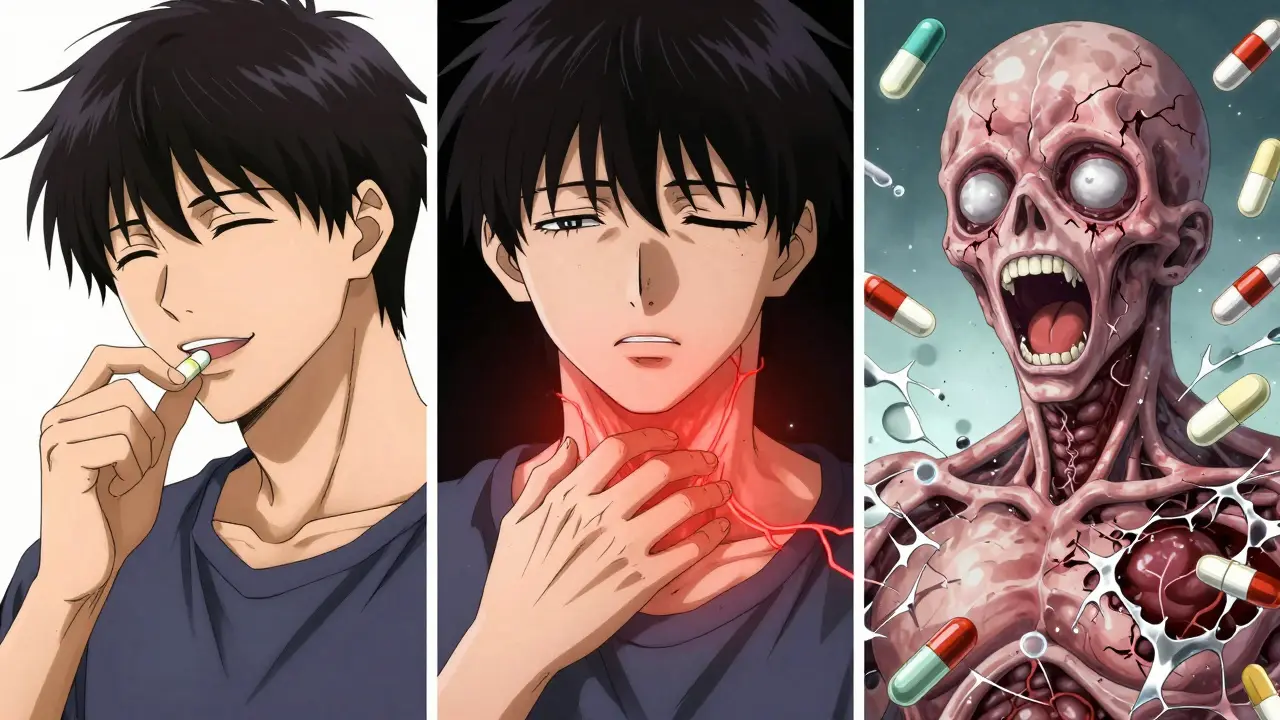
What Happens in the Hospital
If you’re suspected of having SJS/TEN, you’re admitted immediately-usually to a burn unit or ICU. This isn’t a dermatology case. It’s a critical care emergency.
Step one: stop every non-essential drug. No exceptions. Even aspirin or vitamins could be the trigger. Doctors go through your entire medication list-prescription, over-the-counter, supplements-back to the last 3 weeks.
Step two: fluid replacement. Your skin is leaking fluid like a severe burn. You need 3 to 4 times your normal daily fluid intake. Dehydration sets in fast. Electrolytes crash. Kidneys struggle.
Step three: wound care. The raw skin underneath the sloughed-off layers is tender, oozing, and prone to infection. Dressings must be non-stick. Pain control is intense-often requiring IV opioids. Eye care is critical: daily ophthalmology checks to prevent scarring, corneal damage, or even blindness. About half of survivors need lifelong eye drops for dryness.
There’s no magic bullet. IVIG (intravenous immunoglobulin) was once thought to help, but large studies showed no survival benefit. Corticosteroids? Risky-they raise infection chances. Cyclosporine, though, showed promise: one trial cut death rates from 33% to 12.5%. Etanercept, a drug that blocks tumor necrosis factor (TNF), has shown near-zero mortality in small studies when given within 48 hours.
How Bad Is It? The SCORTEN Score
Doctors use a tool called SCORTEN to predict death risk. It’s based on 7 factors measured in the first 24 hours:
- Age over 40
- Cancer history
- Heart rate over 120 bpm
- More than 10% skin detachment
- Blood urea over 10 mmol/L
- Blood glucose over 14 mmol/L
- Bicarbonate under 20 mmol/L
Each factor adds risk. One factor? 3.2% death risk. Three factors? 35%. Five or more? 90%. This isn’t guesswork. It’s validated across hospitals worldwide.
What Survivors Live With
Surviving SJS/TEN doesn’t mean going back to normal. Six out of ten people have lasting damage:
- 50-80% suffer chronic eye problems: dryness, light sensitivity, scarring
- 70% have skin pigmentation changes-dark or light patches that don’t fade
- 40% have scarring on skin or mucous membranes
- 25% lose nails or grow them deformed
- 15% develop urethral strictures; 10% get vaginal adhesions
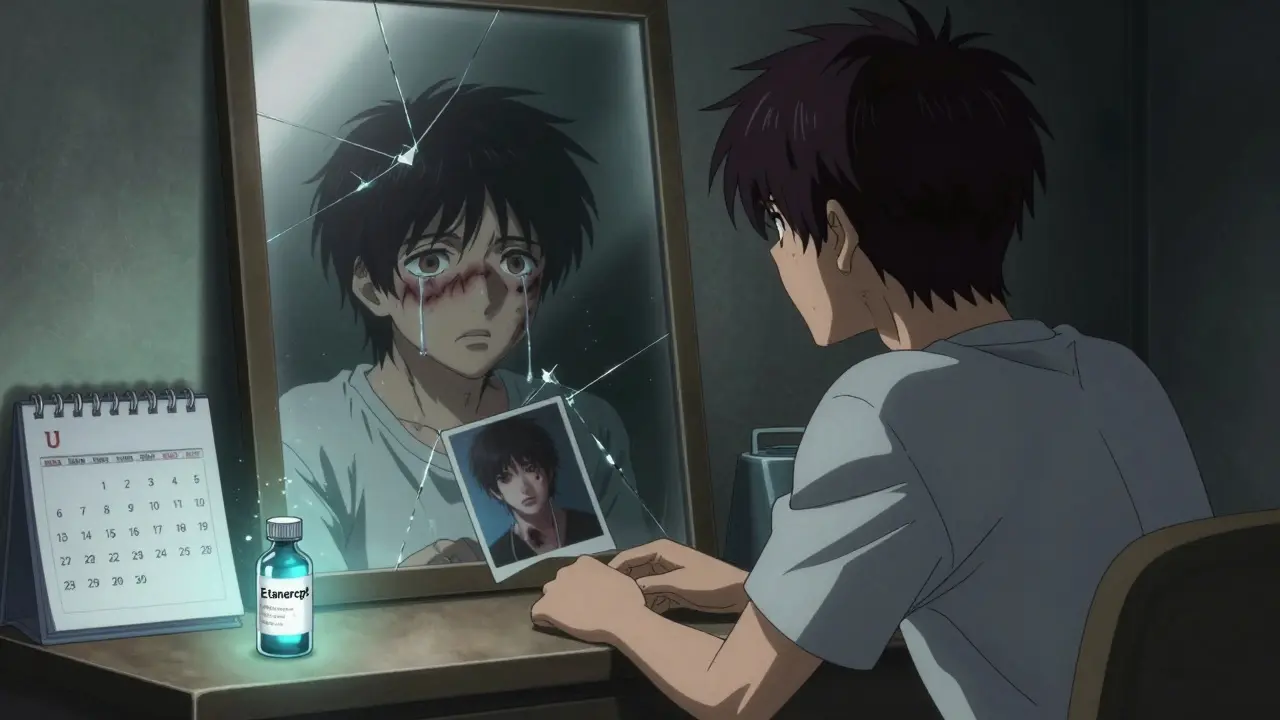
And then there’s the mental toll. Forty percent of survivors develop PTSD. The pain, the isolation, the fear of dying-those memories don’t vanish. Many can’t return to work. Some can’t even look at mirrors.
Can It Be Prevented?
Yes. And it’s simpler than you think.
If you’re prescribed carbamazepine, lamotrigine, or allopurinol, ask: “Do I need an HLA test?” If you’re of Asian descent, that’s non-negotiable. If you’ve had a mild rash before with any of these drugs, don’t take them again.
Never ignore a new rash after starting a medication. Call your doctor immediately-even if it’s just a few spots. Early intervention can mean the difference between recovery and tragedy.
Pharmacogenomics isn’t science fiction. It’s here. Testing is fast, cheap, and widely available. Preventing one case of SJS/TEN saves thousands in ICU costs and countless lives.
What’s Next?
Researchers are now studying drugs that block granulysin-the protein that kills skin cells in SJS/TEN. Phase II trials are set to begin in 2024. If successful, this could be the first targeted therapy.
Meanwhile, global registries like iSCAR track over 1,200 cases to find new genetic links. Every patient’s story adds to the puzzle.
But the biggest win? Awareness. If you’ve ever had a bad reaction to a drug, tell your doctor. If you’re prescribed a high-risk medication, ask about testing. This isn’t about fear. It’s about control.
Can Stevens-Johnson Syndrome be caused by infections?
Yes, though it’s rare. About 10% of pediatric cases are triggered by infections, especially Mycoplasma pneumoniae. In adults, infections are far less common than medications. But if you’ve recently had pneumonia or a severe respiratory infection and then developed a rash and mucosal sores, it’s still possible. Always mention your recent illness to your doctor.
Is Stevens-Johnson Syndrome contagious?
No. SJS and TEN are not contagious. They’re not caused by germs spreading from person to person. They’re your body’s extreme immune reaction to a medication or infection. You can’t catch it from someone else, and you can’t give it to others.
How long does it take to recover from SJS/TEN?
Skin regrowth takes 2 to 6 weeks, but full recovery can take months or even years. The acute phase lasts 8 to 12 days. After that, healing continues slowly. Many patients need months of follow-up care for eyes, skin, and mucous membranes. Some never fully recover their vision or skin texture.
Are children at risk for SJS/TEN?
Yes, but less often than adults. The peak age is 20 to 40 years. In children, infections like Mycoplasma pneumoniae are more common triggers than drugs. Still, medications like carbamazepine and allopurinol can cause it in kids too. Pediatric cases are rarer but just as dangerous.
Why is HLA testing not done for everyone before taking these drugs?
Because the risk varies by ancestry. HLA-B*15:02 is common in Southeast Asians, so testing is mandatory there. In Europe or Africa, the variant is rare, so universal testing isn’t cost-effective. Doctors use guidelines: if you’re from a high-risk group or have a family history of SJS/TEN, testing is recommended. It’s not one-size-fits-all-it’s precision medicine.
Chiruvella Pardha Krishna
February 14, 2026 AT 15:53When I first heard about SJS/TEN, I thought it was some distant medical horror story - something that happened to other people, in other countries. But then I learned about HLA-B*15:02 and how it’s not just genetics - it’s geography, it’s ancestry, it’s a silent timer ticking in our DNA. In India, carbamazepine is prescribed like candy. No testing. No warnings. Just pills. And when the rash comes, it doesn’t ask permission. It takes. Not skin. Not just tissue. It takes your future. This isn’t medicine. It’s a lottery with your life as the prize.
Michael Page
February 16, 2026 AT 01:15The SCORTEN score is chilling because it’s so brutally accurate. One factor: minor risk. Three: you’re in the danger zone. Five or more? You’re already statistically dead. And yet, in many ERs, this isn’t even part of the triage protocol. It’s not flashy. No MRI. No blood culture. Just a checklist of physiological failures. We treat symptoms like emergencies - but we treat the *system* like an afterthought. That’s the real tragedy.
Sarah Barrett
February 17, 2026 AT 17:05There’s something profoundly eerie about how a single pill - something you swallow without a second thought - can unravel the very fabric of your body. The skin doesn’t just peel. It dissolves. Like wax under a flame. And the mucous membranes? They’re not just inflamed - they’re obliterated. It’s not an allergic reaction. It’s a civil war inside you, and the immune system has declared total war. No quarter given. No surrender possible. And the worst part? You didn’t even know you were at war.
Erica Banatao Darilag
February 18, 2026 AT 13:33I work in a hospital, and I’ve seen patients come in with what looks like a sunburn… only to realize it’s not sunburn at all. It’s their skin letting go. And the silence in those rooms - no crying, no screaming - just the beep of monitors and the rustle of non-stick dressings. I’ve never seen anything more quiet, more devastating. Families don’t cry because they’re still hoping it’s a mistake. But we know. We’ve seen it before. And we’re powerless.
Charlotte Dacre
February 18, 2026 AT 18:22So let me get this straight - we have a test that can prevent this nightmare, costs less than a coffee, and takes four hours… but we only do it if you’re from the ‘right’ part of the world? That’s not precision medicine. That’s medical colonialism. If your DNA is ‘expensive’ to test, you get to die quietly. If you’re lucky enough to be Asian, you get a chance. That’s not science. That’s a moral failure dressed in lab coats.
Esha Pathak
February 19, 2026 AT 13:44My cousin took lamotrigine for seizures. One day she had a rash. She thought it was heat. Two days later, her lips were bleeding. Three days later, she was in ICU. They didn’t know what it was until her skin started sliding off like wet paper. She’s alive. But her eyes? Permanent damage. Her nails? Gone. And now she can’t even look at a pill bottle without shaking. They told her it was ‘rare.’ But rare doesn’t mean ‘not me.’ It means ‘not yet me.’
Betty Kirby
February 21, 2026 AT 01:19People act like this is some mysterious medical anomaly. It’s not. It’s negligence wrapped in jargon. Doctors prescribe carbamazepine like it’s Tylenol. Pharmacists don’t ask questions. Patients don’t read the inserts. And when the body screams - ‘I’m dying from this pill’ - no one listens because the label says ‘safe for most.’ But ‘most’ isn’t everyone. And ‘most’ isn’t enough. This isn’t a tragedy. It’s preventable murder.
Josiah Demara
February 22, 2026 AT 18:10Let’s cut through the fluff. HLA testing isn’t ‘expensive’ - it’s underfunded because pharmaceutical companies don’t profit from it. Why? Because if you test before prescribing, you reduce drug sales. Carbamazepine? Allopurinol? They’re billion-dollar drugs. Genetic screening? A one-time $150 test. Who wins? The patient. Who loses? The profit margin. So we keep pretending this is about ‘cost-effectiveness’ when it’s really about corporate calculus. This isn’t science. It’s capitalism with a stethoscope.
Kaye Alcaraz
February 24, 2026 AT 02:14Every time I read this, I think of the nurses who hold the hands of patients whose skin is peeling off. They don’t have magic. They don’t have cures. They have patience. They have dignity. They have the quiet courage to say, ‘I’m here.’ That’s the real treatment. Not IVIG. Not etanercept. Just presence. And if we can’t give patients that, then we’ve already lost.
Daniel Dover
February 25, 2026 AT 17:31Stop. Test. Save.