
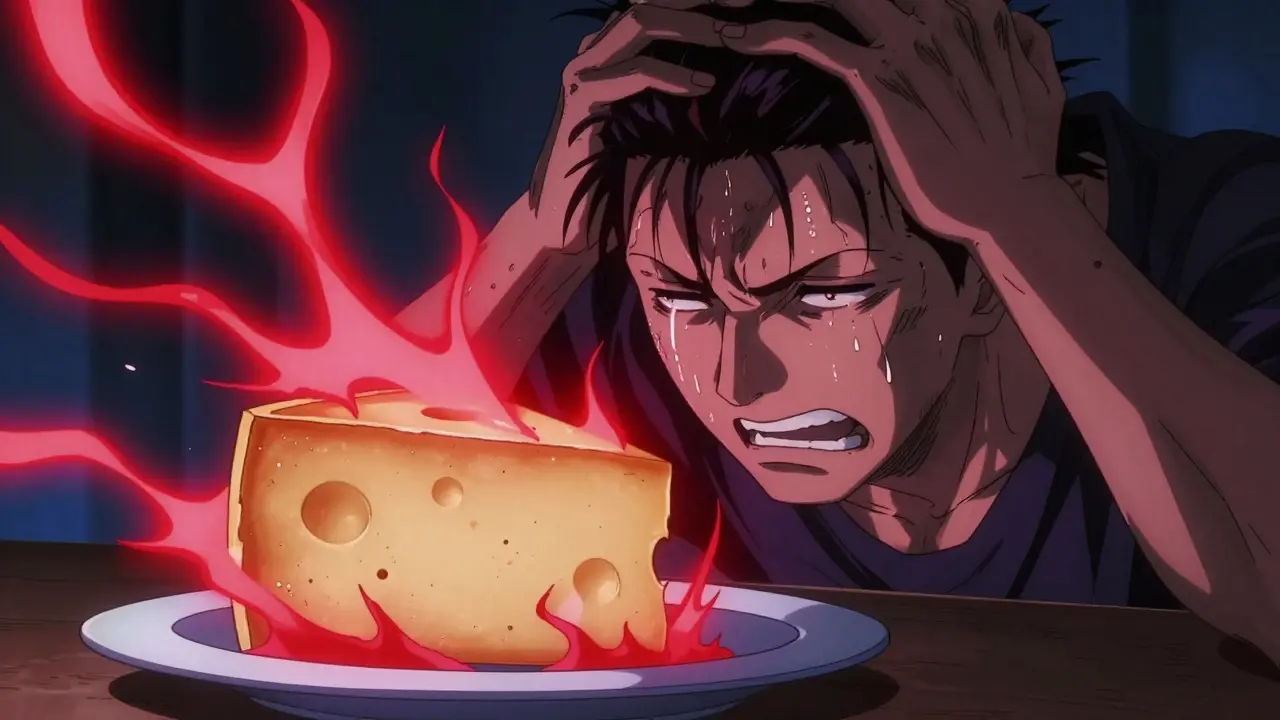
Tyramine Intake Calculator
Calculate Your Tyramine Intake
This tool helps you estimate tyramine content from common foods. The safe threshold is 6mg per serving. Exceeding this increases risk of hypertensive crisis.
Important Safety Information
Remember: The safe threshold is 6mg of tyramine per serving. Your total intake should stay below this limit.
Emergency Alert: If you experience sudden headache, rapid heartbeat, chest pain, or blurred vision after eating, seek emergency medical help immediately.
Always inform healthcare providers you're taking MAOIs. Carry an emergency alert card at all times.
When you're taking an MAOI for depression, what you eat isn't just about nutrition-it can be a matter of life or death. Monoamine Oxidase Inhibitors (MAOIs) like phenelzine, tranylcypromine, and isocarboxazid work by boosting brain chemicals that lift your mood. But they also block a key enzyme in your gut that breaks down tyramine, a compound found naturally in certain foods. Without that enzyme, tyramine builds up fast, triggering a dangerous spike in blood pressure that can lead to stroke, heart attack, or worse. This isn't a rare side effect. It's a well-documented risk that happens within minutes of eating the wrong food.
What Happens When Tyramine Meets an MAOI
Your body normally uses the enzyme monoamine oxidase-A (MAO-A) to break down tyramine after you eat it. This keeps your blood pressure stable. But MAOIs shut down that enzyme-permanently in the case of older drugs like phenelzine. When tyramine slips through unchecked, it floods your system and forces your nerve cells to dump norepinephrine, a natural stimulant. That sudden surge can push your blood pressure past 180/120 mmHg. You might feel a pounding headache, your heart races, you break out in a cold sweat, and your vision blurs. In extreme cases, it can cause bleeding in the brain. The Mayo Clinic calls this a hypertensive crisis, and it demands emergency care.
Which Foods Are Dangerous?
Not all foods carry the same risk. Tyramine levels rise as food ages, ferments, or spoils. Fresh food is usually safe. The danger comes from aged, cured, or fermented products.
- Aged cheeses: Cheddar, Swiss, blue cheese, Parmesan, and Camembert can contain 50 to 400 mg of tyramine per 100 grams. One slice of aged cheddar can have 30 mg-enough to trigger a reaction.
- Dried or cured meats: Salami, pepperoni, summer sausage, and corned beef contain 50 to 100 mg per 100 grams. Even a small sandwich topping can be risky.
- Fermented soy: Traditional soy sauce, miso paste, and tempeh are high in tyramine. Commercial soy sauce is lower (around 30 mg per 100 ml), but traditional versions can hit 500 mg.
- Overripe fruits: Bananas, avocados, and figs are fine when fresh, but once they start to soften or brown, tyramine levels climb. An overripe avocado can contain up to 10 mg per 100 grams.
- Tap beer and draft beer: These contain 10 to 30 mg per 100 ml because they're unpasteurized and still fermenting. Bottled or canned beer is usually safe in small amounts.
- Red wine: Chianti and other aged red wines can have 10 to 20 mg per 100 ml. White wine and champagne are lower. Spirits like vodka or whiskey are generally safe in moderation.
- Yeast extracts: Marmite, Vegemite, and bouillon cubes made with yeast extract can contain high levels.
It’s not about avoiding everything. You can still eat fresh chicken, fish, eggs, most vegetables, and fresh fruit. Pasteurized dairy like milk, yogurt, and cottage cheese are safe. The key is knowing what’s aged or fermented.
Not All MAOIs Are the Same
There’s a big difference between the old-school MAOIs and the newer ones. If you’re on phenelzine or tranylcypromine, you need to be strict. But if you’re using the transdermal patch form of selegiline (Emsam) at 6 mg/24 hours, your risk drops dramatically. That’s because the patch delivers the drug through your skin, bypassing your gut-where most tyramine breakdown happens. At this dose, you don’t need to change your diet at all.
Oral selegiline at doses above 10 mg/day still requires dietary caution. Newer reversible MAOIs like moclobemide are even safer-they let your body clear tyramine naturally if it builds up. But these aren’t widely available everywhere. In the U.S., Emsam is the most common MAOI today, making up 75% of all MAOI prescriptions as of 2023.

What About Over-the-Counter Medicines?
It’s not just food. Many cold and allergy medicines can be just as dangerous. Decongestants like pseudoephedrine and phenylephrine are stimulants that can cause the same blood pressure spike when mixed with MAOIs. Check labels carefully. Avoid any product with “decongestant,” “sinus relief,” or “cold and flu” unless your doctor says it’s safe. Even some herbal supplements like St. John’s Wort or certain energy boosters can interact badly.
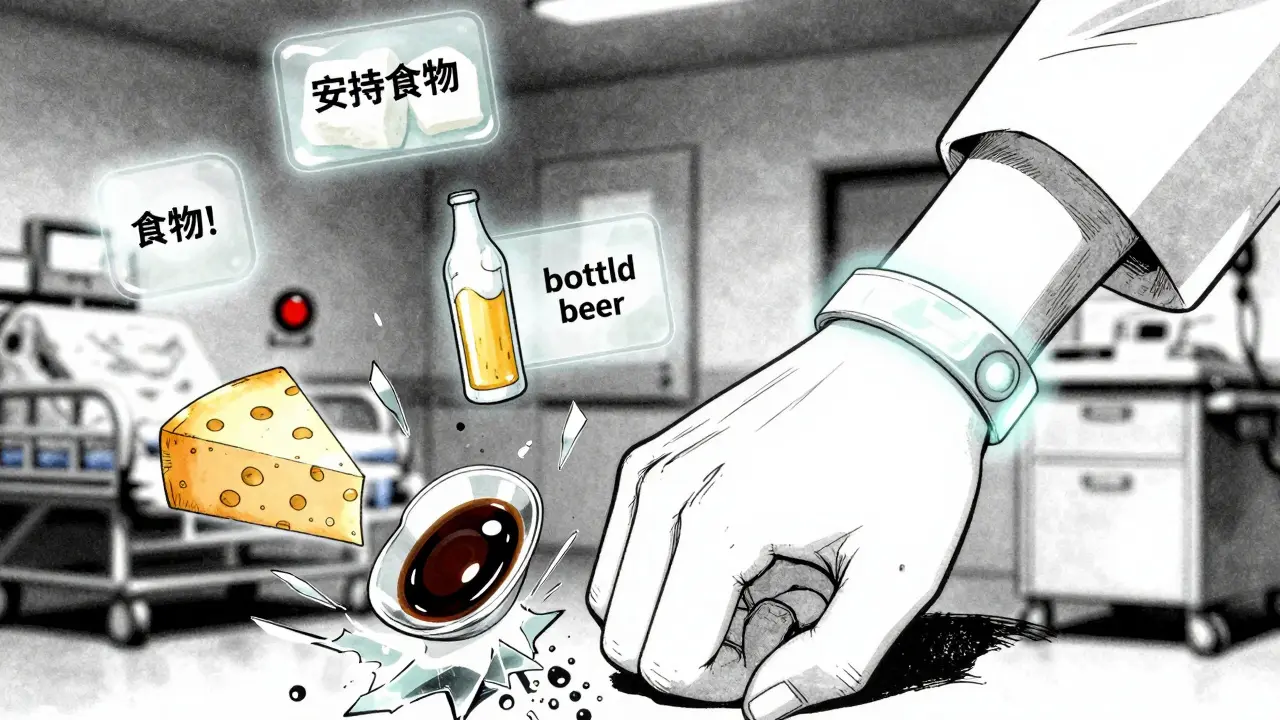
Always carry an MAOI alert card or wear a medical ID bracelet. Emergency responders need to know you’re on an MAOI-especially if you’re unconscious after a hypertensive crisis. Many people don’t realize how fast this reaction can happen, and giving the wrong medication can be fatal.
How Long Do You Need to Stay on the Diet?
You can’t just stop your MAOI and go back to eating aged cheese the next day. The enzyme your body needs to break down tyramine takes 2 to 4 weeks to regenerate after stopping an irreversible MAOI. That means you must stick to the diet for at least two weeks after your last dose. Some doctors recommend three to four weeks to be safe.
And if you’re switching to another antidepressant-like an SSRI such as sertraline or fluoxetine-you must wait at least 14 days after your last MAOI dose. Mixing them can cause serotonin syndrome, a life-threatening condition where your brain gets flooded with too much serotonin. There have been documented cases of death when this happened without proper washout.
What’s Changed in Recent Years?
Back in the 1960s, MAOIs were feared because of their strict diets and scary side effects. But today, doctors have a much better understanding of the risks. Research shows that with proper education, the chance of a hypertensive crisis drops below 0.5% per year. That’s lower than many common medications.
The American Psychiatric Association updated its guidelines in 2020 to reflect this. They now say dietary restrictions are “significantly reduced” with transdermal selegiline and “not required” for low-dose patches. Food manufacturers have also reduced tyramine levels in many products through better processing. Commercial soy sauce today has far less tyramine than the homemade version from 50 years ago.
Still, the rules aren’t gone-they’re just smarter. Instead of saying “avoid all cheese,” experts now say: “avoid aged cheese with more than 6 mg of tyramine per serving.” That’s why patient education materials from the University of Iowa and other medical centers now list exact amounts: one tablespoon of soy sauce = 15 mg, one ounce of salami = 50 mg.
When to Talk to Your Doctor
If you’re prescribed an MAOI, ask for a written list of safe and unsafe foods. Don’t rely on memory. Some pharmacies offer printed guides. Ask about your specific medication-is it irreversible? Is it a patch? What’s the dose? These details change everything.
Also, tell every doctor, dentist, or pharmacist you see that you’re on an MAOI. Even a simple painkiller like meperidine (Demerol) can cause serious reactions. And if you ever feel a sudden, severe headache, chest tightness, or a rapid heartbeat after eating-call 911. Don’t wait. This isn’t something to ride out.
MAOIs aren’t first-line treatment anymore. They’re reserved for depression that hasn’t responded to other drugs. But for people who’ve tried everything else, they can be life-changing. The key isn’t fear-it’s knowledge. Know your medication. Know your food. Know your limits. With that, you can stay safe and get better.
Can I drink alcohol while taking MAOIs?
Moderate amounts of wine, beer, or spirits are generally safe if they’re not high in tyramine. But tap beer and draft beer are risky because they’re unpasteurized and contain live yeast that produces tyramine. Bottled or canned beer is usually okay in small amounts. Red wine like Chianti has moderate tyramine (10-20 mg per 100 ml), so limit it to one glass. Spirits like vodka or whiskey are low in tyramine and typically safe. But alcohol can lower blood pressure and interact with the sedative effects of MAOIs, so always drink cautiously and never mix with other drugs.
Are fresh cheeses safe with MAOIs?
Yes, fresh cheeses are safe. Cottage cheese, ricotta, cream cheese, mozzarella, and fresh cheddar (not aged) contain less than 10 mg of tyramine per 100 grams. The danger comes from cheeses that have been aged for weeks or months-like cheddar, Swiss, blue cheese, or Parmesan. Always check the label: if it says “aged,” “sharp,” or “mature,” avoid it. Stick to the ones labeled “fresh” or “unaged.”
Can I eat soy sauce if I’m on an MAOI?
Traditional fermented soy sauce can have up to 500 mg of tyramine per 100 ml-dangerously high. But most store-bought soy sauce in the U.S. is pasteurized and contains around 30 mg per 100 ml. One tablespoon (15 ml) would be about 4.5 mg, which is under the 6 mg threshold. Still, avoid bulk or imported versions without labels. If you’re unsure, use low-sodium or tamari soy sauce, which are often safer. Always check the ingredient list: if it says “naturally brewed,” it’s riskier.
What if I accidentally eat a high-tyramine food?
If you eat something like aged cheese or salami and feel a sudden headache, pounding heartbeat, chest pain, or blurred vision, sit down and call emergency services immediately. Do not wait. These symptoms can worsen in minutes. Keep your MAOI medication bottle handy for medical staff. If you’re alone, ask someone to stay with you. Most reactions happen within 30 to 90 minutes after eating. Don’t take any other medications, including blood pressure pills, unless instructed by a doctor.
Do I need to avoid all fermented foods?
No-not all. Fermented foods like yogurt, kefir, and sauerkraut are generally low in tyramine because they’re made with different bacteria than those used in cheese or soy sauce. The main concern is with foods that undergo long-term fermentation with tyramine-producing bacteria: aged cheese, cured meats, soy sauce, miso, and tap beer. Fresh sauerkraut from the refrigerated section is usually safe. If it’s shelf-stable and unpasteurized, check with your doctor.
Can I take MAOIs if I’m vegetarian or vegan?
Yes, but you’ll need to be extra careful with plant-based proteins. Many vegan protein sources like tempeh, miso, and soy sauce are high in tyramine. Tofu is safe if it’s fresh and unfermented. Lentils, beans, nuts, and fresh vegetables are all fine. Your biggest risks will come from fermented soy products and yeast extracts like Marmite or nutritional yeast (which can be high in tyramine). Always read labels and choose products labeled “unfermented” or “fresh.”
Why do some people say they eat aged cheese without problems?
Some people are on newer MAOIs like the Emsam patch at low doses, where dietary restrictions don’t apply. Others may be on reversible MAOIs, which are less likely to cause reactions. In rare cases, people may have a naturally higher level of MAO enzymes or metabolize tyramine faster. But assuming you’re on a traditional MAOI and eating aged cheese without symptoms doesn’t mean it’s safe-it means you’ve been lucky so far. One bite could be the one that triggers a crisis.
Linda Caldwell
December 17, 2025 AT 05:34Just started my MAOI journey and this post saved my life. Seriously. I was about to grab a slice of blue cheese for my burger. Now I know better. Thank you.
Jonathan Morris
December 17, 2025 AT 21:52Actually, the FDA's 2021 pharmacovigilance report shows 17 documented cases of hypertensive crisis linked to mislabeled 'low-tyramine' soy sauce in 2020 alone. Labels lie. Always test with a home tyramine strip if you're paranoid. And yes, I am.
Brooks Beveridge
December 19, 2025 AT 02:42Hey, I get it-this stuff sounds scary. But you’re not alone. I’ve been on Emsam for two years now. I eat sushi, drink wine, even had a slice of aged cheddar once… and I’m still here. Knowledge > fear. Talk to your doc, get the right dose, and live. You’ve got this.
CAROL MUTISO
December 20, 2025 AT 08:38Let’s be real-MAOIs are the goth punk of antidepressants. Loud, misunderstood, and unfairly demonized. I used to think I’d have to live on steamed broccoli and plain tofu. Turns out? Fresh mozzarella, a glass of white wine, and a good book are still allowed. The diet isn’t a prison. It’s a playlist. And you get to curate it.
Sam Clark
December 20, 2025 AT 13:51It is imperative to emphasize that the regulatory guidelines promulgated by the American Psychiatric Association in 2020 constitute a paradigm shift in clinical management of monoamine oxidase inhibitor therapy. Dietary restrictions are now stratified by pharmacokinetic profile, not blanket prohibition. This represents a significant advancement in patient-centered care.
Chris Van Horn
December 21, 2025 AT 23:13Oh wow. So I’m just supposed to believe that ‘commercial soy sauce’ is safe? You know who makes that stuff? Big Pharma’s cousins at Big Food™. They’ve been hiding tyramine in ‘natural flavors’ since 1998. I’ve seen the patents. You’re being manipulated. Also, I once ate a whole wheel of Parmesan and lived. So take your ‘guidelines’ and shove them.
Virginia Seitz
December 22, 2025 AT 20:06fresh cheese = 🟢
aged cheese = 🔴
tap beer = 🚫
whiskey = ✅
you got this 💪
amanda s
December 24, 2025 AT 09:16Why are we even letting people take these drugs? In India, they just use yoga and turmeric. We’re so weak. You think you’re special because you need chemicals to feel okay? Just toughen up. This is America. We don’t need to baby people with food rules.
Peter Ronai
December 24, 2025 AT 12:15Everyone’s acting like this is new info. I’ve been on phenelzine since 2003. I’ve had three hypertensive crises. I’ve seen people die from this. You think you’re being smart by eating ‘just one bite’? You’re not. You’re just waiting for your obituary to be written. Wake up.
Steven Lavoie
December 26, 2025 AT 10:37My grandma took MAOIs in the 70s. She ate everything-blue cheese, salami, even homemade soy sauce. Never had an issue. Maybe it’s not the food. Maybe it’s the dose. Or your liver. Or your genes. We’re over-simplifying this. Science is messy.
Michael Whitaker
December 26, 2025 AT 13:39Let me just say, as someone who has read every peer-reviewed paper on MAOIs since 2012, your post is… adequate. But you missed the 2021 meta-analysis by the European Psychiatric Association which showed that tyramine thresholds vary by CYP2D6 polymorphism. Also, your reference to ‘one slice of cheddar’ is statistically inaccurate. It’s 30 mg ± 8.7 mg. Precision matters.
Anu radha
December 26, 2025 AT 14:35I am from India. My uncle took MAOI. He ate curd rice and fresh vegetables. He is fine. I think if you eat fresh, you are safe. Thank you for sharing.
Jigar shah
December 27, 2025 AT 04:48Interesting. Do you have data on tyramine levels in fermented rice products like idli batter or kanji? I’ve heard they’re low, but I’m not sure. Could be useful for vegan MAOI users in South Asia.
Brooks Beveridge
December 27, 2025 AT 06:22Hey @JigarShah - good question. Idli batter is generally safe because it’s fermented for less than 24 hours with lactic acid bacteria, not tyramine-producing ones. Kanji? That’s trickier. If it’s aged over 7 days and left at room temp, yeah, skip it. But if it’s fresh and refrigerated? Probably fine. Always test small amounts first.