

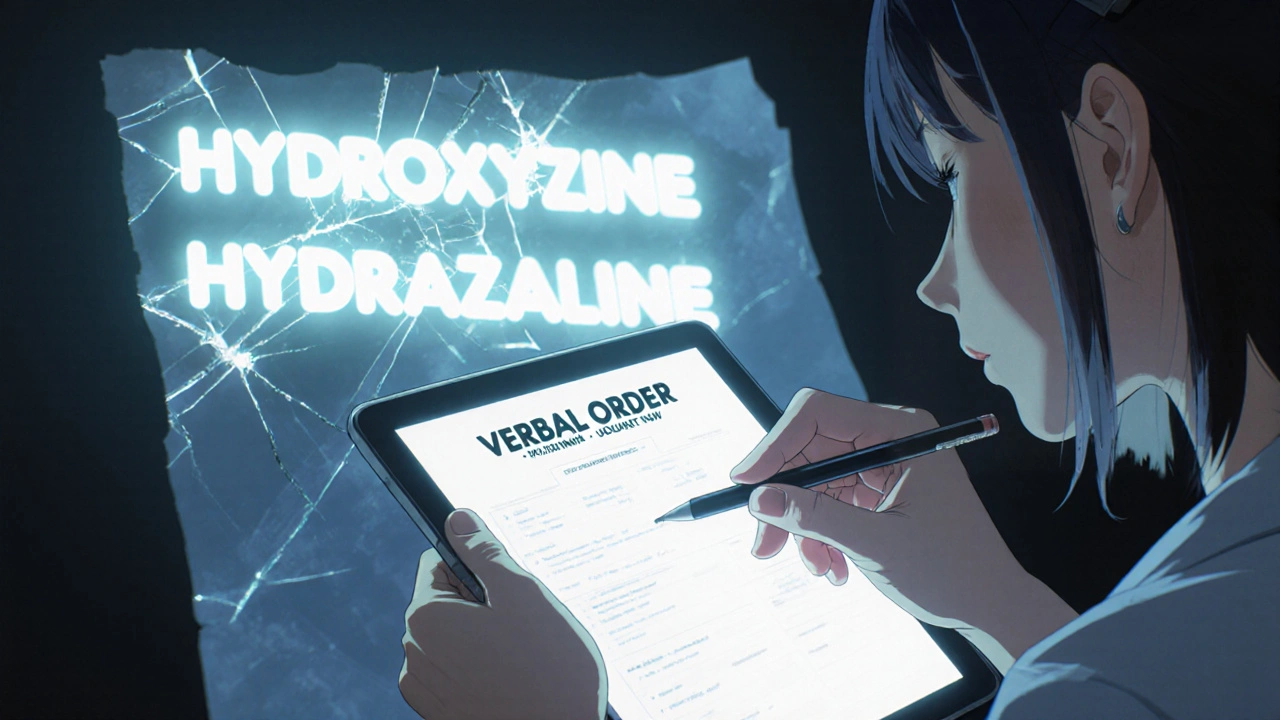
Every year, thousands of patients in hospitals and clinics are affected by medication errors - and a surprising number of them start with a simple spoken sentence: "Give her 50 milligrams of hydralazine." What sounds like a routine order can turn deadly if the word "hydralazine" is misheard as "hydroxyzine" - two drugs that sound almost identical but do completely different things. One lowers blood pressure. The other treats anxiety. Giving the wrong one can cause a heart attack, a stroke, or even death.
Verbal prescriptions - orders given out loud by doctors over the phone or in person - are still common in healthcare, even in 2025. They’re used in emergencies, during surgeries, in busy ERs, and when electronic systems fail. But they’re also one of the riskiest parts of patient care. Studies show that without proper safeguards, verbal orders have a 30-50% error rate. That’s not a small risk. That’s a systemic problem.
Why Verbal Prescriptions Still Exist
You might wonder: if electronic prescribing is so accurate, why do we still use verbal orders? The answer is simple: sometimes, there’s no time. In trauma rooms, operating theaters, or during cardiac arrests, typing into a computer isn’t an option. A surgeon needs antibiotics now. A nurse needs to adjust insulin before a patient goes to radiology. Waiting 30 seconds to log in and click through menus could cost a life.
According to the Agency for Healthcare Research and Quality (AHRQ), verbal orders still make up 10-15% of all medication orders in hospitals - and up to 25% in emergency departments. In clinics and rural settings with limited tech access, that number is even higher. They’re not going away. But they don’t have to be dangerous.
The Read-Back Rule: Your Lifesaving Checklist
The single most effective way to prevent errors from verbal prescriptions is the read-back - a simple, non-negotiable step that’s been required by The Joint Commission since 2006.
Here’s how it works:
- The prescriber says the full order: "Give Mr. Lee 10 milligrams of hydralazine intravenously now, for systolic blood pressure over 180."
- The receiver repeats it back exactly: "You want 10 milligrams of H-Y-D-R-A-L-A-Z-I-N-E, IV, now, for systolic BP over 180?"
- The prescriber confirms: "Yes, that’s correct."
It sounds basic. But in practice, it’s often skipped. A 2020 Joint Commission survey found that 63% of nurses reported prescribers resisting read-backs - sometimes because they’re rushed, sometimes because they think they’re "too experienced" to make mistakes.
Don’t be fooled. Even experienced doctors mishear things. A 2021 Medscape survey of 1,200 nurses showed 68% had at least one near-miss incident every month because a prescriber mumbled, rushed, or used unclear pronunciation. That’s not negligence - it’s human error. And read-backs are the only proven way to catch it.
How to Say It Right: Avoiding Sound-Alike Traps
Some drug names are nightmares to say out loud. Hydralazine and hydroxyzine. Celexa and Celebrex. Zyprexa and Zyrtec. These aren’t just similar - they’re dangerously close in sound. The Institute for Safe Medication Practices (ISMP) says sound-alike confusion causes 34% of all verbal order errors.
Here’s what you must do every time:
- Spell out the drug name letter by letter. Say "H-Y-D-R-A-L-A-Z-I-N-E," not just "hydralazine."
- State the dose in two ways. Say "ten milligrams, that’s one-zero milligrams."
- Never use abbreviations. Say "by mouth," not "PO." Say "twice daily," not "BID." Say "intravenous," not "IV" - unless you’re in a code blue and even then, spell it out.
- Clarify the indication. Don’t just say "give insulin." Say "give 8 units of regular insulin subcutaneously for blood sugar over 250 mg/dL."
One nurse in Cape Town shared a story from 2023: a doctor ordered "hydralazine 50 mg IV." She spelled it out. He said, "No, I meant hydroxyzine." She asked why. He admitted he’d typed the wrong drug in his EHR and was trying to fix it verbally. The read-back saved the patient from a dangerous sedative in a hypertensive crisis.
High-Alert Medications: When Verbal Orders Are Forbidden
Not all drugs should ever be ordered verbally. The Pennsylvania Patient Safety Authority and the Institute for Safe Medication Practices agree: certain medications are too dangerous to risk miscommunication.
Verbal orders should be prohibited for:
- Insulin (except in emergencies like DKA)
- Heparin (especially IV infusions)
- Opioids (morphine, fentanyl, hydromorphone)
- Chemotherapy agents (except to hold or discontinue)
- Concentrated electrolytes (potassium chloride, sodium chloride)
Even in emergencies, these drugs should be ordered through a second provider if possible. If not, use the read-back, spell everything, and document immediately. Johns Hopkins Hospital’s policy requires two licensed providers to verify any verbal order for insulin - and that’s the gold standard.
Documentation: The Only Real Record
Here’s the hard truth: the only real record of a verbal order is in the memory of the person who heard it. And human memory fails. Especially under stress.
Every verbal order must be documented immediately - not later, not during the next break, not when you have time. Within minutes, the nurse or clinician receiving the order must enter it into the electronic health record (EHR) with:
- Patient’s full name and date of birth
- Exact drug name spelled out
- Dose with units (e.g., "10 milligrams," not "10 mg")
- Route (oral, IV, IM, SC)
- Frequency (e.g., "every 6 hours," not "Q6H")
- Reason for the order (indication)
- Name and title of the prescriber
- Exact time the order was received
- Time the order was documented
CMS requires authentication by the prescriber within 48 hours. But leading hospitals like Mayo Clinic and Kaiser Permanente require it before the shift ends. If the doctor doesn’t sign off, the order isn’t valid. And if the nurse doesn’t document it, it never happened.
Who’s Responsible?
Some people think verbal orders are the doctor’s problem. They’re not. They’re everyone’s.
The prescriber must speak clearly, avoid distractions, and never rush. The receiver must listen, repeat, question, and document. The pharmacist must verify before dispensing. The nurse must double-check before administering.
And if you hear something that doesn’t sound right - even if it’s your boss, your mentor, or your favorite doctor - say something. Ask: "Can you spell that drug again?" or "Did you mean 5 mg or 50 mg?"
That’s not being difficult. That’s being safe.
What’s Changing in 2025?
Electronic prescribing (CPOE) has cut verbal order rates by more than half since 2006. But they’re not disappearing. Voice recognition tools are improving, and AI-powered EHRs can now suggest corrections in real time - like flagging "hydralazine" when someone says "hydroxyzine."
But technology won’t fix culture. The real change is happening in training. More hospitals now require staff to complete 3-5 supervised verbal order sessions before they’re allowed to take them independently. And 42 U.S. states now legally require read-backs to be followed - not just recommended.
The FDA is also launching a new initiative in 2025 to standardize how high-risk drug names are pronounced across the country. Think of it like a national safety dictionary for medication names.
Final Rule: When in Doubt, Stop
There’s no shame in asking for clarification. There’s no shame in saying, "I’m not sure." There’s no shame in asking a second person to verify.
One nurse on AllNurses.com wrote: "I once stopped a 10-fold dosing error because I asked the doctor to spell out hydralazine. He said, ‘Oh, I meant hydroxyzine.’ I almost cried. That was my patient’s life."
Verbal prescriptions aren’t going away. But every error from one is preventable. The tools are simple: spell it, read it back, document it, verify it. And if you’re ever unsure - stop. Ask. Double-check. Because in healthcare, clarity isn’t just good practice. It’s the only thing standing between a patient and harm.
linda wood
November 30, 2025 AT 08:23So let me get this straight - we’re still risking lives because someone doesn’t want to type out a drug name? 😒 I get emergencies, but if your EHR is too slow to handle a 10-second order, maybe it’s time to upgrade. Or hire someone who can actually read a keyboard.
LINDA PUSPITASARI
December 2, 2025 AT 07:10YESSSS this is so real 😭 I once heard "heparin 5000" and thought it was "heparin 500" - turned out the doc said "five thousand" but mumbled like he was chewing gum 🤦♀️ Read-back saved me. Spell everything. Even if you're tired. Even if they're your boss. Even if you've been on shift for 14 hours. SPELL IT. 🙏
gerardo beaudoin
December 2, 2025 AT 16:54Yeah read-back works. Simple. No drama. Just say it back. Done. Doctors should do it. Nurses should do it. Everyone should do it. No exceptions. It’s not hard. It’s just basic.
Joy Aniekwe
December 4, 2025 AT 16:05Oh wow. Another article about how nurses are the only ones keeping patients alive while doctors nap and mumble. Shocking. Truly. The real problem? The system lets doctors act like they’re above procedure. But hey, at least we get to clean up their messes. Again.
Latika Gupta
December 5, 2025 AT 06:30I work in a rural clinic in India. We don’t even have EHR. We write on paper. Then someone calls the pharmacy. Sometimes the script is illegible. Sometimes the name sounds like "hydralazine" but is actually "hydroxyzine." I’ve had to call back three times just to confirm. I don’t sleep well anymore.
Sullivan Lauer
December 6, 2025 AT 16:24Let me tell you something - I’ve been in this game for 27 years. I’ve seen patients die because someone didn’t spell out a drug. I’ve seen nurses cry because they were blamed for a mistake that wasn’t theirs. I’ve seen residents who think they’re too cool for read-backs - until they’re the ones standing over a dead patient with a clipboard in their hand and no one to blame but themselves. This isn’t theory. This is blood on the floor. And the fix? It’s not AI. It’s not fancy tech. It’s two people talking. One says it. One says it back. And then they both mean it. That’s it. That’s all. No magic. No shortcuts. Just human responsibility. And if you’re too busy for that? You shouldn’t be holding a stethoscope.
Matthew Higgins
December 8, 2025 AT 10:16Man, I work in the ER and this hits hard. Last week, a guy came in with chest pain, we were doing code, and the attending yells "epinephrine 1 mg IV!" - I didn’t say it back. Thought I heard right. Turned out he meant 0.1 mg. We caught it in time because the med cart had the wrong concentration. But holy hell. That was too close. Now I say it back every single time. Even if the doc rolls his eyes. Even if I’m sweating bullets. I say it back. Always.
Mary Kate Powers
December 8, 2025 AT 12:37This is such an important reminder. We’re all human. We all get tired. We all make mistakes. But the read-back? It’s not a burden - it’s a gift. It’s the moment you choose to protect someone instead of rushing past them. And that’s what healthcare is supposed to be about. Thank you for writing this. Please share it everywhere.
Sara Shumaker
December 10, 2025 AT 03:57It’s interesting how we’ve built entire systems around minimizing risk - from double-checks to barcode scans - yet we still cling to the most fragile, unreliable tool we have: human speech. And then we act surprised when it fails. Maybe the real question isn’t how to make verbal orders safer - but why we still tolerate them at all. If we can’t trust our ears, why do we keep using them as the primary medium for life-or-death decisions? Maybe it’s not about better protocols. Maybe it’s about admitting that speech is broken as a safety tool - and moving on.
Scott Collard
December 10, 2025 AT 12:52Read-backs are for nurses. Real doctors write orders. Not repeat them. If you can’t hear correctly, maybe you shouldn’t be on the floor.
Brandy Johnson
December 12, 2025 AT 10:12It’s pathetic. American healthcare is so dysfunctional that we’ve institutionalized verbal orders as a norm - while other developed nations have eradicated them entirely. This isn’t innovation. This is negligence dressed up as tradition. And the fact that we’re still debating whether to spell out drug names? That’s not incompetence. That’s moral failure.
Peter Axelberg
December 12, 2025 AT 17:29I’ve worked in 12 hospitals across the Midwest. I’ve seen it all. From the guy who says "Zyprexa" like "Zippy-exa" to the resident who writes "KCL 10" and means 10 mEq but says "ten milliequivalents" like it’s a math problem. The worst? The ones who say "IV push" and mean IV drip. No one’s teaching this stuff anymore. No one’s holding people accountable. And the worst part? Everyone knows it’s wrong - but no one wants to be the one to say it. So we all just keep pretending it’s fine. Until it’s not.
Monica Lindsey
December 13, 2025 AT 22:39Spelling out drug names? That’s kindergarten-level safety. If you need that, you shouldn’t be licensed.
Bernie Terrien
December 14, 2025 AT 09:10Hydralazine. Hydroxyzine. One’s a vasodilator. The other’s a sedative. Say one wrong and you’re basically playing Russian roulette with someone’s brainstem. And the fact that we’re still having this conversation in 2025? That’s not a medical failure. That’s a cultural one. We treat safety like an afterthought. Until someone dies. Then we write a memo. And forget it by Monday.