
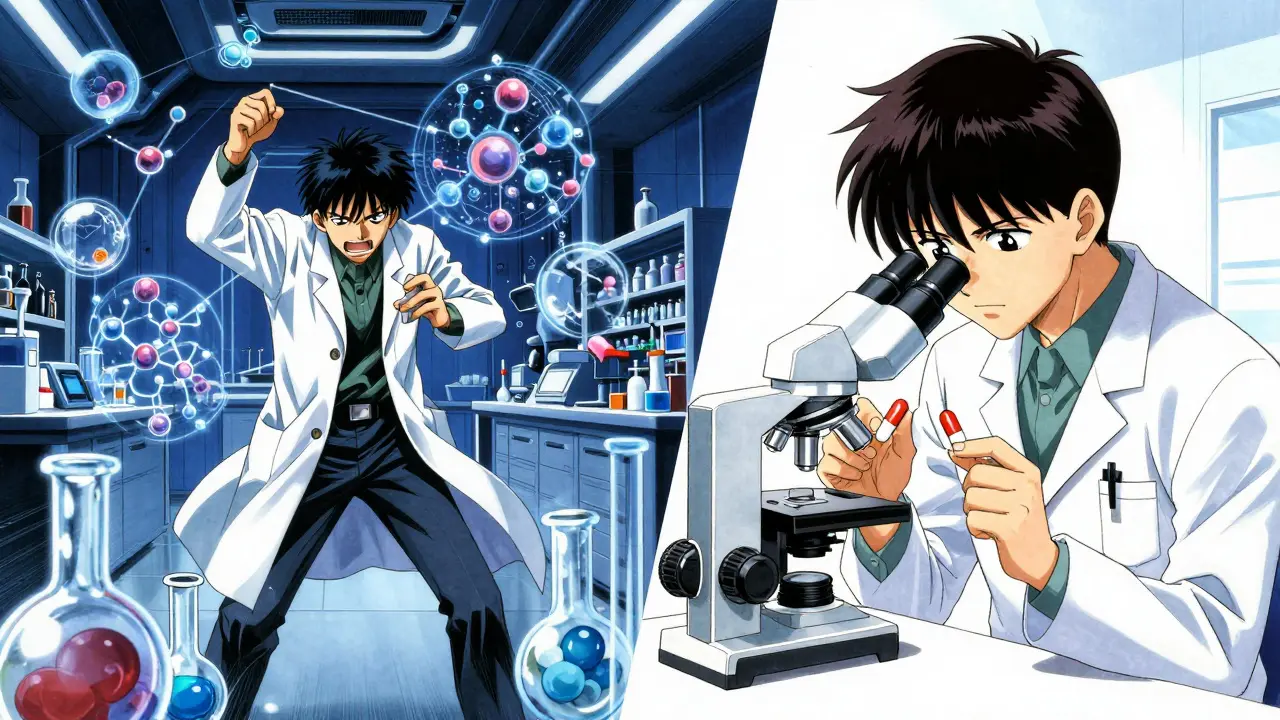
The R&D Gap: Innovation vs. Replication
The biggest driver of cost isn't the actual pill-pressing; it's the decade of failure that precedes it. For a brand-name company, creating a new drug is a high-stakes gamble. According to the Tufts Center for the Study of Drug Development, developing a novel drug takes about 10 to 15 years and costs an average of $2.6 billion. This figure includes all the failed attempts, the thousands of molecules that didn't work, and the massive cost of large-scale clinical trials.
Generic manufacturers don't play that game. They wait for the patent to expire and then use the Abbreviated New Drug Application (ANDA) process. Instead of proving the drug works from scratch through years of human trials, they only need to prove bioequivalence-essentially showing that their version delivers the same amount of active ingredient to the bloodstream in the same amount of time as the original. This drops the development cost from billions to a mere $2 million to $5 million per drug.
Breaking Down the Production Costs
Once the drug is approved, the cost structure shifts to the factory floor. Generic producers operate on razor-thin margins, where production costs can consume up to half of their total revenue. To survive, they focus on a very lean Cost of Goods Sold (COGS). A typical breakdown for a major generic firm looks like this: about 30% goes to internal manufacturing, 4% to supply chain operations, and around 3-5% to above-site overhead.
The primary cost driver is the Active Pharmaceutical Ingredient (API). This is the actual chemical that treats the condition. API costs are volatile, sometimes swinging 20-30% in a single year based on where the raw materials are sourced. Other costs include excipients (the inactive fillers that give the pill its shape), quality assurance systems to keep the FDA happy, and the final packaging.
| Cost Factor | Branded Drugs | Generic Drugs |
|---|---|---|
| Development Cost | ~$2.6 Billion (High) | $2-5 Million (Low) |
| Clinical Trials | Full Phase I, II, III | Bioequivalence only |
| Marketing Spend | Heavy (TV, Physician reps) | Minimal to None |
| Time to Market | 10-15 Years | ~36 Months (via ANDA) |
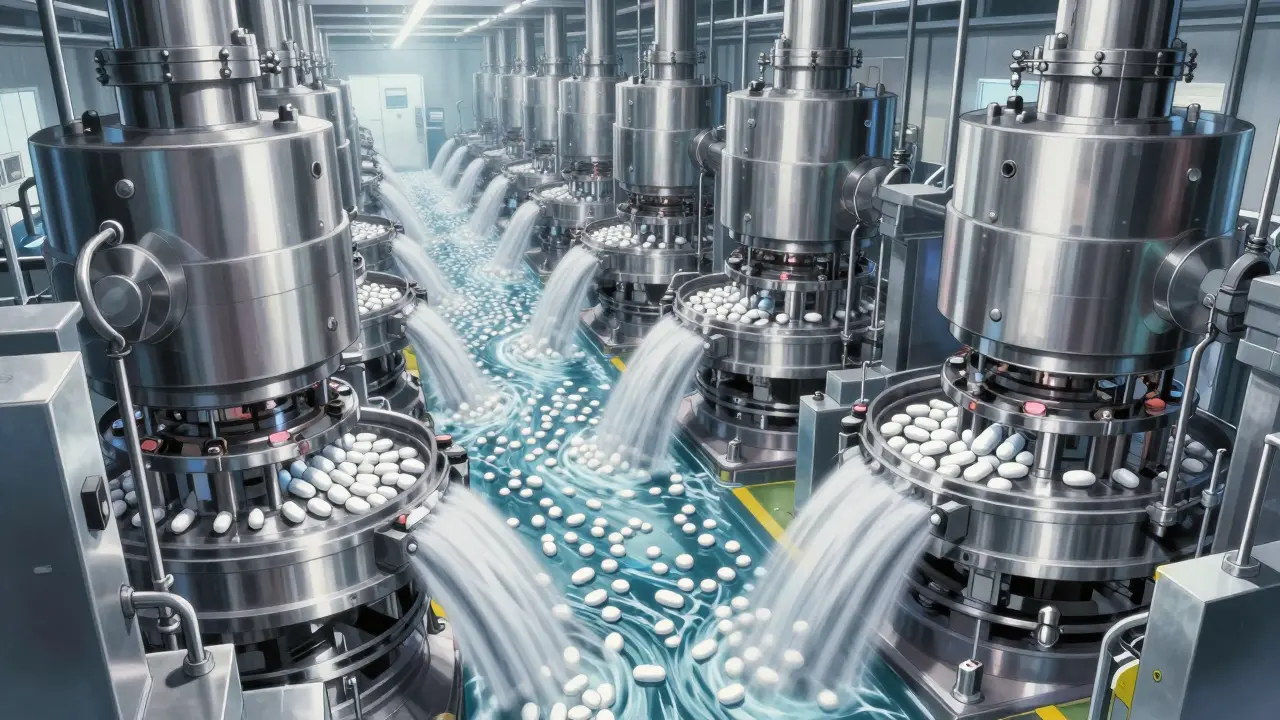
The Power of Scale and the Learning Curve
Generics thrive on volume. In the pharmaceutical world, there is a phenomenon called the "learning curve." Every time a company doubles its production volume, the per-unit cost typically drops by 18%. If they can double the volume for a specific SKU (Stock Keeping Unit), that unit cost can plummet by as much as 45%.
This is why you see such dramatic price drops when a drug becomes generic. When only two companies compete, the price might be 54% lower than the brand. But when six or more competitors enter the fray, prices can crash by more than 95%. This hyper-competition forces manufacturers to optimize every single second of machine time. For a generic firm, a 1% improvement in efficiency isn't just a bonus-it's often the difference between staying in business or shutting down.
Where Generics Struggle: Complexity and Supply Chains
It's not all easy wins. While simple pills (Oral Solid Dosage) are cheap to make, "complex generics" are a different story. Things like inhalers, injectable biologics, or extended-release patches require much higher manufacturing sophistication. These act as barriers to entry, keeping prices higher because fewer companies can actually make them.
There is also a darker side to this efficiency. Because margins are so tight, the supply chain is fragile. When the cost of an API spikes or a single factory in India or China goes offline, there's no financial cushion to fall back on. This has led to a rise in drug shortages, as some manufacturers simply stop producing low-margin drugs that are no longer profitable to make.
The Future of Low-Cost Production
The trend toward cheaper meds isn't stopping. We are now seeing the rise of Biosimilars, which are essentially generics for complex biologic drugs. While they are harder to make than chemical pills, they are following the same cost-reduction trajectory. Experts predict that investments in automation and continuous manufacturing will shave another 20-25% off production costs by 2027.
At the same time, geopolitical shifts are happening. Many companies are trying to move API production away from a heavy reliance on China. This "diversification" might actually make drugs slightly more expensive in the short term-perhaps a 5-8% increase-but it's a trade-off for better security and fewer shortages.
Are generic drugs lower quality because they are cheaper?
No. Regulatory bodies like the FDA require generics to be bioequivalent to the brand-name drug. This means they must have the same active ingredient, strength, dosage form, and route of administration, and they must work in the body in the same way.
Why does the price of a generic drug sometimes go up?
This usually happens due to API shortages or a decrease in the number of competitors. If several manufacturers exit the market because the profit margins are too thin, the remaining companies have more pricing power.
What is the difference between a generic and a biosimilar?
Generics are copies of simple chemical drugs (small molecules). Biosimilars are copies of large, complex proteins made in living cells. Because biologics are more complex, biosimilars are "highly similar" rather than identical copies.
How much does a generic manufacturer actually spend on R&D?
While they don't do primary discovery, they spend between $2 million and $5 million to develop the formulation and prove bioequivalence through the ANDA process.
Does the government regulate generic pricing?
In the US, pricing is largely driven by market competition. However, recent legislation like the Inflation Reduction Act has introduced mechanisms for Medicare to negotiate certain drug prices, which can put further downward pressure on costs.
Next Steps for Patients and Providers
If you're looking to save on healthcare costs, the most immediate action is to ask your provider if a generic equivalent exists for your current prescriptions. For those in the industry, the focus is shifting toward diversifying the API supply chain to prevent the shortages that come with "too-lean" manufacturing. Whether you are a patient or a policy maker, understanding that the low cost of generics is a result of eliminated R&D and massive scale-rather than lower quality-is key to making informed health decisions.
Darius Prorok
April 7, 2026 AT 07:38Pretty basic stuff. Everyone knows the FDA bioequivalence rules are what keep the prices low since the hard work is already done.
Grace Lottering
April 7, 2026 AT 23:09Follow the money. Big Pharma just wants us dependent on these cycles. They control the patents to bleed us dry first!!!
Nathan Kreider
April 9, 2026 AT 03:11It's actually really heartening to see how competition can make life-saving meds so much cheaper for people who are struggling. Just feels like a win for everyone in the end!
Benjamin cusden
April 10, 2026 AT 19:43The analysis of the learning curve is quaint, but it fails to account for the nuanced regulatory capture that often delays generic entry. One should actually look into the 'pay-for-delay' agreements if they want a sophisticated understanding of market dynamics rather than this superficial overview of COGS.
Victoria Gregory
April 11, 2026 AT 12:20I love how we can find a middle ground here! ✨ It's all about balance between rewarding the inventors and helping the public... right?? 😊💖
Laurie Iten
April 11, 2026 AT 15:18makes me think about how we define value in a society that prizes innovation only when it's profitable the systemic reliance on a few hubs in india and china is just a fragile way to handle human health
Windy Phillips
April 13, 2026 AT 12:26It is truly fascinating, isn't it, how some people believe a simple chart explains the tragedy of our healthcare system... One wonders if the authors realize the emotional toll of these "fragile supply chains." 🙄
GOPESH KUMAR
April 14, 2026 AT 06:59The paradox here is that we worship the end product while ignoring the structural decay of the process. You call it efficiency, I call it the commodification of survival. We've reached a point where the chemical's value is decoupled from its utility and tied strictly to the expiration of a legal document. It's a systemic failure masked as a market victory, and frankly, anyone who thinks the ANDA process is just "streamlined" is missing the larger philosophical point about who actually owns the right to health in a capitalist framework. We are essentially betting our lives on the hope that a factory in a different time zone doesn't have a power outage. It's absurd. Absolutely absurd. We pretend the 95% price drop is a miracle, but it's actually a symptom of a race to the bottom where the only winners are those who can cut costs the fastest without getting caught by a distracted regulator. This isn't innovation; it's an exercise in extreme minimalism. We've optimized the soul out of medicine. Truly, we are just numbers in a spreadsheet of bioequivalence. The arrogance of thinking this is a solved problem is the real disease here. We aren't solving healthcare; we're just making the pills cheaper so we can ignore the lack of actual care.
Kathleen Painter
April 15, 2026 AT 08:36I think it's important to remember that while the numbers look great on paper, there's a human element to this whole production chain that often gets overlooked in these technical breakdowns. If we want to move toward a more sustainable model, we should probably look at how we can support smaller, localized manufacturers so we aren't just relying on a few massive entities to keep the prices low through sheer volume, which, as the post mentions, leaves us very vulnerable to shortages. It's a bit like a garden; if you only plant one type of crop because it's the most efficient, one bad storm wipes everything out, and that's exactly what's happening with our API sourcing. We need a more diverse ecosystem where quality and security are valued as much as the bottom line, and maybe that means accepting a slightly higher price for a more resilient system that doesn't leave patients stranded when a single factory halfway across the world goes offline.
Nikhil Bhatia
April 17, 2026 AT 01:40Whatever, sounds like a lot of reading for something that just means drugs are cheaper now.